Posts

Showing posts with the label FremontCo-CO

Willamson's Sapsucker in bright, fresh plumager

Image
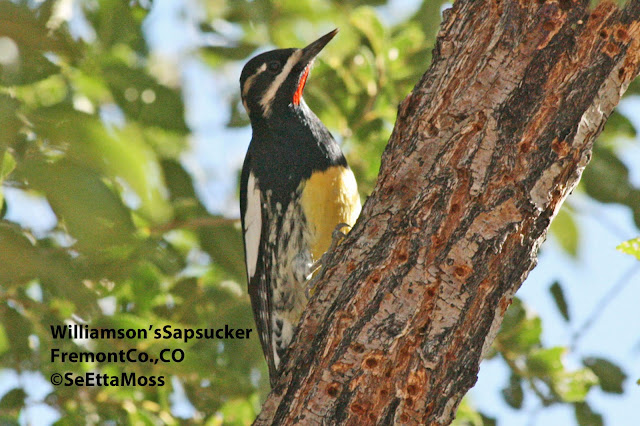
Late posting as I found this male Williamson's Sapsucker on Oct 10. He was south of Canon City in a dry gulch that runs through an area with pinyon and some ponderosa pines. I have found Williamson's Sapsuckers in this dry gulch in fall in previous years as well as many sapwells to indicate these birds must be migrating down through dry gulches.  Interestingly in these dry gulches I have found them most of the time on Siberian elm trees like the one pictured here.  However, when they go into Canon City they spend a lot of time also on non native trees but mostly on conifers like Scots and Austrian Pine.   These male Williamson's Sapsuckers are most handsome in fresh plumage.  SeEtta

Scissor-tailed Flycatchers: my last photo of female & she was on the nest

Image
I took this photo on July 28 of the female in the pair of rare Scissor-tailed Flycatchers that were nesting south of Florence. I was on my way out of town and forgot I had this photo that was good enough to crop a lot for a closer view than I had published before. And it turned out this was the last day the female was seen that I have been able to find out-though I was out of town and she may have still been around another few days (when I returned and looked for them on Aug 2 I did not find the female so queried other birders). Do not know if something happened to the female or if there was a nest failure that caused her to leave. The location has snakes (per landowner) and there could be badgers around (a few weeks ago I saw a badger late in the day while driving about a mile from this location). There also was bad weather with thunderstorms and heavy rain during that period. And though the male stayed in the area for more than a week after the female had not been seen, he m...

Rare Scissor-tailed Flycatcher south of Florence, CO: the female

Image
All the photos I got earlier this week were of the male Scissor-tailed Flycatcher and all the photos I have seen posted on Facebook and ebird have also been of the male. I had a meeting in a town not far from the location these rare birds have been located so dropped by just after 6:30 pm. When I saw her it was obvious this was the female as her tail is much shorter than the males. She did not stay put though and this was the only photo I got of her before she flew off. I couldn't stay but a few minutes to get this pic as I had to go the meeting but I returned afterwards at close to 8 pm. I saw the female perched on the tree on which she and the male have most often been seen, mostly right above the nest that is there. I did not see the male tonight. She flew off for about 5 min then returned briefly then flew off to unknown location at about 8:15 as it got dark. SeEtta

Common Merganser pair together

Image
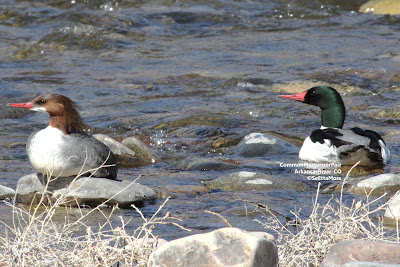
These two Common Mergansers were taking advantage of a spot in the Arkansas River where they could rest and do some grooming. I stayed in my car and shot just a few photos so as not to disturb them since there are now a lot of fishermen on the river making it difficult for birds like this to be undisturbed. I was pleased to see them staying put as I drove away. SeEtta

Handsome Common Merganser pair

Image
I spotted this pair of Common Mergansers loafing in a slow section of the Arkansas River near Coaldale (west of Canon City) a few days ago. I think they make a handsome couple. SeEtta

A few more pics of rotor/wave clouds west of Canon City, CO

Image
I took these photos with my new Canon 60d dslr camera, which allowed me to take them at 1/8000 of a second at F16, using my Canon 70-300mm lens. This provides better photos, I think, of these ephemeral cloud formations. I took the top photo less than 10 seconds after the photo that is in the previous post (in which I used my older Canon xti dslr camera with the same lens but at only 1/4000 of a second which the limit for this camera). I took the top photo above of the same cloud formation but only about a minute earlier and from the same location at Brush Hollow Reservoir as the bottom photo, but used a 200mm setting for the top and 300mm for the bottom pics. Click on photos to enlarge for best views. SeEtta

More rotor/wave clouds due to continuing high winds in Colorado

Image
Colorado continued to have high winds so as I drove around yesterday doing my birding I watched as rotor/wave clouds formed and dissipated. Though many formed into rotor/wave clouds, caused by Kelvin-Helmholz instability , they tended to be pretty wispy and dissipated quickly. This was about the best one, at least in coming out more definitively as a photo. I took this photo from Brush Hollow Reservoir near Penrose,CO looking west past Canon City. More to come from the day before. SeEtta

Uncommon hawk in Fremont County, CO: a Swainson's

Image
I found this adult Swainson's Hawk south of Florence, CO and still within Fremont County tonight. They are uncommon in my county though usually found in the small amount of remaining grasslands either south or east of Florence. I found it not long after I spotted a wildfire that had just begun in the Wet Mountains just west of this area. My long telephoto lens combo on my dslr camera came in handy as I was able to show a photo of the wildfire location to the fire fighters (by the time they arrived the smoke had gone down and it is difficult to point out a location on top of distant mountains). The wildfire was likely started by lightening as there were thunder storms all around and the fire fighters thought the rain may put out the fire. SeEtta

Pair of imm Harris Sparrows still in rural Fremont County,CO

Image
Today I refound the pair of immature Harris's Sparrows I originally found about 6 weeks ago. I have looked for them on several occasions since first finding them but had not seen them again until today. The two immature birds fed and stayed together just as they did when I first watched them--apparently siblings that have migrated to Fremont County from their northern Canada where this species breeds. They are unusual as they are not apparently going to a feeder where most Harris's Sparrows are found in Colorado. They are in a rural area where I don't believe anyone feeds birds, but near cattle feeding. I spotted the bird in the top pic eating a seed at the side of the road where the two were feeding on weeds. I have found the Harris's Sparrows in association with White-crowned Sparrows, members of the same sparrow family. By the way, the flecks in these pics are snow flakes--the snow was coming down at a pretty good clip. SeEtta

Snow Goose and Golden Eagles

Image
After the Red-tailed Hawk fight I found this immature Snow Goose (in Basic I plumage) with a small flock of Canada Geese at Holcim Wetlands in Fremont County. White geese are quite uncommon here. I also saw 3 Golden Eagles earlier this afternoon--a juvenile soaring then a pair of adults flying circling together (possibly courtship behavior). Very nice afternoon birding. SeEtta

Red-tailed Hawks fight over female

Image
This afternoon I watched a pair of hawks engaged in some aerial courtship displays--first flying near each other at low elevation, then soaring in circles together at high elevation then a series of dives then ascents (like a roller coaster). They landed in a nearby tree as did a third Red-tailed Hawk so I drove closer as I didn't think this threesome would work. Right after I took the top pic the hawk on the top of the tree in that pic flew down and attacked the hawk just visible on the far bottom right which is shown in the second pic. The hawks moved away from the tree and continued their combat in the air as shown in the third pic. This ended quickly and the apparent victor flew off with the female. SeEtta

Also Bushtits

Image
I found these little male Bushtits in a small flock in the same general area, in a dry wash, as the Williamson's Sapsuckers, near Canon City,CO. These acrobatic little birds were feeding as shown in rabbit-brush, a wonderful native plant whose seeds are eaten by a number of bird species after it's blossoms that provide nectar for butterflies, moths, bees and other insects are gone. SeEtta

More on Williamson's Sapsucker

Image
This photo shows the brilliant colors of the fresh plumage of this male Williamson's Sapsucker.  In sunlight this bird gorgeously bright.  Also visible in this pic are some of the fresh sap wells that have been drilled into this elm tree limb. I stopped again tonight near dusk and refound this male still drilling at 6 pm.  I didn't see the female and the male flew off into the pinyon-junipers shortly after I spotted him.  SeEtta

Gorgeous Williamson's Sapsuckers near Canon City,CO

Image
Yesterday I found the adult male Williamson's Sapsucker seen in the top two pics in the few deciduous trees (of all things, Siberian elms) in a normally dry wash that are supported by the small amount of water that runs off a gravel road and through the wash. When I saw him yesterday, I thought he was just a latish bird that had made a down-slope move from their breeding habitat in conifers at a higher elevation to the pinyon-juniper foothills near Canon City. I didn't have much time to observe him yesterday so I returned today I found not only the male but a female Williamson's Sapsucker in the same elm tree but that the several small elms here had hundreds of sap wells drilled in many of the limbs--it would seem more likely that one or both of these birds had been here for some time. Canon City has hosted one or more Williamson's Sapsucker, usually females, every winter for the several years but in very different habitat. In Canon City they have wintered in park-l...

Western Scrub Jay

Image
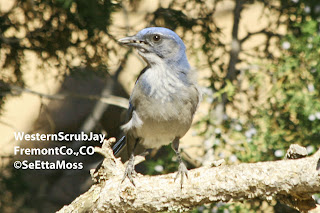
This is one of the Western Scrub Jays that were performing acrobatics to get seed from a hanging feeder with tiny perches meant for smaller birds at my friend Gail's home in pinyon-juniper habitat a little west of Canon City, CO. A couple of Juniper Titmice came into nearby trees as did one Pinyon Jay (there was a flock not far away so this may have been a scout checking out the food supply). SeEtta

Black-throated Gray Warbler

Image
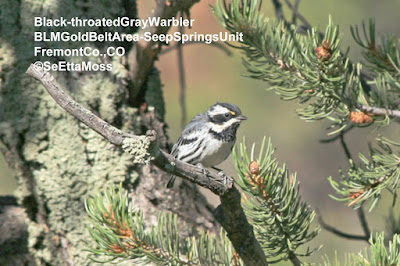
Late yesterday afternoon I drove through part of the Seep Springs unit of the BLM Gold Belt Area in Fremont Co,CO checking to see if the motorized use was staying on designated routes so as not to tear up the nice pinyon-juniper habitat, a small bird flew in front of my car. I stopped quickly and scanned the pinyon pines about 25 feet away until I spotted this adult male Black-throated Gray Warbler. These warblers use mature pinyon-juniper habitat "almost exclusively" according to the Colo Breeding Bird Atlas I . Since this small bird (only 5 inches long) was so far away relative to it's size, I had to push the cropping of these pics but they show it's field marks well--gray back and wings with 2 white bars, black crown, throat and eye stripe, white eyebrow and malar stripe, black streaks on sides with white underparts plus small yellow spot in front of eye--very distinctive male plumage. The bottom pic shows the dark tail with white outer feathers on the upper side...

Bighorn sheep ewes with lambs

Image
Yesterday I spotted this small herd of Rocky Mountain Bighorn sheep as I drove home through Bighorn Sheep Canon here in Fremont Co.,CO (near where John Christo wants to put his 'over the river' panels which is projected to draw several hundred thousand people to this canyon in a two period). I didn't try to get out of my car but as soon as I turned off my engine the herd starting moving away even though I was about 75 feet from them. Just goes to demonstrate that though Bighorn sheep will often stand in place even when people are near, that depends upon the tolerance level of the specific sheep and such factors as whether they have young lambs with them as this herd did (actually there were 2 lambs with these 4 ewes but the other lamb was out of the photo). Not all creatures engage in fight or flight, some just freeze in place--this species has demonstrated that their heart rates go up when people are near with evidence that this makes them susceptible to disease later ...

Hawk nesting on cliff by a cave

Image
I have followed this female Red-tailed Hawk for several breeding seasons in an area near Canon City, CO. The first year I observed her nesting, she choose a very precarious small ledge on a steep cliff--but it held and her young fledged successfully. The next year she nested in a less precarious location by some large boulders. Sadly I saw one of her fledglings wedged, and apparently dead, head first in a vertical opening in a nearby cliff area--maybe a wind gust caused it to dive head first into the opening where it was unable to get free, very sad. This year she choose this nice size ledge on another cliff which has a cave behind it. This is very convenient as both she and her young have been able to retreat into the cave to avoid the hot afternoon sun. She built at least a good section of nest on the ledge as much nest material can be seen outside the cave part and she tends to perch on the nesting material on the ledge most of the times I have seen her and only occasionally re...

Tricolored Heron-another short video clip

This very short video clip is a little difficult as the Tricolored Heron is behind tall cattails and the video camera does not always focus well as it moves quickly about but it provides a view of how the heron engages in 'dart' feeding. It is probably best to run it at least 2 times to see the heron as it is moving rapidly through most of the clip and the picture shakes as I have difficulty holding the camcorder totally still when I have it extended to it's full 40X optical zoom. At the end the heron is standing still behind the cattails. SeEtta

Great Blue Herons engaged in breeding

Image
Though I have continued taking some good bird pics, I have wanted to move to a higher level with a high quality and longer telephoto zoom. I finally took the big step and my new Canon EF400mm 5.6 USM lens arrived today. I had to go try some bird pics so I drove to a herony where I have been frustrated as I hadn't been able to get very good pics because I won't risk disturbing these nesting birds by going too close even though I stay in my car to reduce disruption. So I took several pics of a small group of Great Blue Herons that were either on the nest or still building nests. Then I stopped to watch and give them a break from the noise that the electronics in digital cameras make. I was closely watching a pair that were standing very close together in their partially built nest. Then one of the herons mounted the other to engage in breeding. I had my camera with the new lens still leaning on my window so I was able to quickly shoot a number of pics of them as they copul...