Posts

Showing posts with the label OteroCounty-COLO

Long-billed Curlew chick

Image
As can be seen in these pics this Long-billed Curlew chick is still in it's hatchling stage down. This is a very young chick, at least younger than 2-3 weeks old (age when female leaves the parenting to the male) and I suspect only a week or so old. Note: I used my longest lens combination (that is the equivalent of about 900mm) to photograph this Federally listed Species of Concern so I was usually over a hundred feet from the chick (except when I was photographing from inside my car and the chick approached within about 60 feet of my stationary car parked on road--that is when I got the top pic) then cropped the pics to enlarge them. SeEtta

Long-billed Curlew with mother

Image
The mother curlew is near the chick in both of the bottom pics as it forages in the grassy area (actually a lot of forbs). According to Nature Works , "Shortly after birth their parents will lead them to the feeding ground where they will hunt for invertebrates like grasshoppers." This very young chick was quite independent and spent little time near either of it's parents during the almost 2 hours I observed them. In the middle pic the female is looking skyward, watching for aerial predators (not long after this a Turkey Vulture flew over followed by an explosion of both parents as they flew up to escort it away from their chick). SeEtta

Long-billed Curlew family with young chick

Image
Yesterday I took advantage of a 'cool' front that dropped the temperatures in Otero County from around 100 to the 80's. I returned to look for the Long-billed Curlew pair that I found last year with several chicks. I found the male and female in the lower pics only about a half mile from where I had seen the pair last year so believe this is the same pair. Actually the grass in the field where I saw them the most last year was in poor condition--there is a severe drought in that area plus it appears the ranchers overgrazed those fields (grass fields right across the road were short but healthy looking). Long-billed Curlews are known for nest site fidelity but I suspect the poor condition of the fields they were in last year prompted a move down the road. The chick shown in the top pic is quite young, actually a nestling but since this species is precocial . More pics to follow. SeEtta

Colorado shorebird: Baird's Sandpiper

Image
A common sandpiper in Colorado, this little Baird's was the only shorebird I saw at Lake Henry when I visited last week. I did see a distant flock of flying shorebirds but they were too far away to identify. SeEtta

Always like to see Burrowing Owls

Image
This is one of the four Burrowing Owls I found in a prairie dog town in Otero County, Colorado. Burrowing Owls are migrating south for the winter and these will likely do so soon.SeEtta

Migrating Sparrows: the Vespers

Image
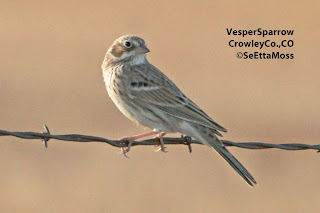
This is one of a number of small flocks of migrating Vesper Sparrows I saw in Otero County, CO earlier this week. Though they such beautiful singers, they are quiet this time of year.  SeEtta

Another Turkey Vulture, but w/o tubercles

Image
I should have added this guy yesterday for comparison. This Turkey Vulture is without tubercles on it's face, or virtually without. There is a hint when I enlarge the photos a blurry stage of possible tubercles begining, but it gives a good comparison for the ones on the former post that have a moderate amount of white tubercles. SeEtta

Turkey Vulture-too close for visual comfort

Image
This Turkey Vulture was with a large group, most flying but a few others hanging out on a fence, in Otero County. The top pic shows an adult Turkey Vulture with a moderate amount of white tubercles on it's face with "black hairlike feathers on lores surrounding the tubercles" as described in Raptors of Western North America . You can see the tubercles up close by double-clicking on the pic (tho the photo gets blurry it shows the features). The bottom pic is of the same bird but with it's nictitating membrane over it's eye.

Wary Burrowing Owl

Image
I spotted this Burrowing Owl standing by a burrow in a field that houses a praire dog town in northern Otero Co. As soon as I stopped the car, this wary little owl ducked down into the burrow then peeked over the edge. Unfortunately it is necessary for these beautiful little owls to be frightened of humans since they are at risk of those who enjoy shooting prairie dogs either from a stray bullet or someone who just shoots anything that moves. SeEtta

W Kingbird fledglings all in a row

Image
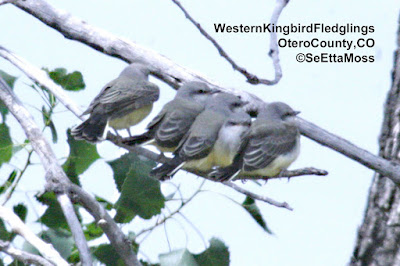
Though a little far away for good pic of these small bird, these fledglings were just too cute all lined up on a branch especially with the one facing the opposite direction to pass up for a passable pic. SeEtta

Long-billed Curlews-last video clip of adult female

This is another video clip showing the adult female foraging almost as close as in the other one As in the other clip she appears to find tasty morsels; and the dark stripes on her crown are clearly visible hear also. This is the last of the video clips of my viewing of this Long-billed Curlew family on June 23. SeEtta

Long-billed Curlew-younger chick & male video clip

In this video clip the younger chick in the Long-billed Curlew family in northern Otero County, CO is seen with the adult male standing behind (and watching vigilantly). This clip shows the chick trying to cool off in the upper 80's temps, which are the movements around the throat area as it 'vibrates the muscles and bones in it's throat', a technique called 'gular fluttering' . Young birds do not have well developed thermoregulatory function so have to supplement with techniques like this. After loafing for a bit, the chick does some grooming and then some stretching. SeEtta

Long-billedCurlew--short clip of male landing

This is a pretty short but interesting video clip showing the adult male Long-billed Curlew, that had flown to a new foraging spot, flying back in and is seen landing. There is a good view of his plumage as he lands. Though the wind is seen blowing the grasses in this (as well as the other video clips), some heat waves can be seen in the background. Still more videos to come. SeEtta

Long-billedCurlew older chick in Otero Co,,CO family

This is a composite of two short video clips of the older chick in the Long-billed Curlew family I have been following in Otero County, CO. This chick is loafing, looking around, first in a closer lowland area then on top of a hill--meanwhile the adult female forages nearby while the adult male and the younger chick forage across the road. Like the younger chick, it is more pinkish than the adults and appears to lack the dark crown stripes found on the adult birds. It's bill is almost as long as the adult male's bill. In the first section of this clip dragonflies can be seen in blurry silhouette flying in front of the camcorder. Towards the end of the video a smaller bird flies between the curlew and the camcorder. SeEtta

Long-billedCurlew female foraging-great video clip

This is a very good but short video clip of adult female foraging, apparently fairly successfully, about 60-75 feet away. I didn't approach her at this close of a distance (I believe she would have fled if I had approached this close--I find birds will approach closer and behave more naturally like this bird when they are given their personal distance to work with),she walked this close to where I was video-ing the family. Nice native grasses billow in the brisk breeze that has come up. SeEtta

Long-billed Curlew-video clip of younger chick

This is the younger chick in the Long-billed Curlew family I have been following in northern Otero County,CO. This video clip provides some very good views as the chick is only about 125 feet away. It's quite short bill is clearly seen and the light is good so the pinkish underparts are evident. The chick mostly looks around but then does a little stretching which provides some interesting views. The adult male, though out of view, is only about 100 feet away. There is a prairie dog town in the background and at least one prairie dog can be seen in the clip. Also some heat waves are visible in the background. More Long-billed Curlew family clips to follow. SeEtta

More very good pics of the female Long-billed Curlew

Image
The female curlew was most accommodating in posing for a number of still pics and video. She did appear to be trying to figure out what was making the click that my dslr makes when I snap a photo and would turn her head sideways as shown in the middle pic--maybe trying to triangulate the sound? While the female foraged, she stayed within about a hundred feet of the older chick over which she was watching just as the male did with the chick he was watching. She called occasionally, presumably to maintain contact with the chick and maybe with her mate too. SeEtta

Adult female Long-billed Curlew

Image
The top pic of the female Long-billed Curlew is my favorite--she is emitting the distinctive 'cur-lee' call. I got these very good pics of the female as she approached as close as 60-70 feet from me as she foraged. I've got some great video of her foraging but that will have to wait as I have to edit it and post it to youtube before posting it here. SeEtta

Long-billedCurlew male & chick

Image
In the top pic the male curlew can be seen standing not far from the younger chick (about 30-40 feet in this pic). He was a vigilant parent, staying within about a hundred feet and calling frequently to keep contact. When I moved my car closer to the canal, it called loudly and flew up in air (though it didn't fly towards me so not sure that was a true aggressive display, maybe just a warning display?????) to make it's displeasure known and warn the chick. The bottom pic shows the male bird alone as it watches the chick on the other side of the canal. SeEtta

Long-billedCurlews--the first chick?

Image
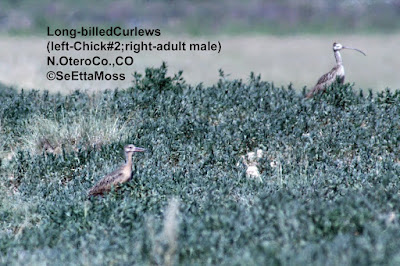
After the young chick I photographed in the post below disappeared from view, I drove my car another feet closer to the canal in hopes I could refind the chick. Though I didn't see it again for awhile, I noticed the adult female curlew on the other side of the road on top of the canal on that side. Then I spotted a chick not far from the female--this turned out to be different and older chick (clearly longer bill) than the one I had first seen. Aha!--this pair of curlews has two chicks. The male was watching the younger one on one side of the road and the female was watching the older chick on the other side of the road. The best part for me was that the chicks were not as distant from the road as the one I watched and photographed last week (presumably this, the older chick) which provides better photos (and much better video, but I haven't edited that yet). This older chick spent most of the next hour and half I watched just loafing in about the same place while the fema...