Posts

Showing posts with the label Yellow-rumpedWarbler

Audubon's Yellow-rumped Warbler with bright new plumage

Image
The top pic shows several field marks for Yellow-rumped Warbler :  yellow rump showing, streaked gray upperparts,broken white eye ring and white corners on tail.  And, of course, it's fully yellow throat shows it is the subspecies found in the west, Audubon's. The pic above adds the following field marks:  yellow patch on side and 2 white wing bars. And the final pic shows the dark breast band and a little of the yellow crown patch.  FouSeEtta

Yellow-rumped Warbler, Myrtle race

Image
Just a couple of pics of a Myrtle race Yellow-rumped Warbler I photographed on the Canon City Riverwalk this morning. We get both Myrtle and Audubon's all along the Arkansas River corridor and seem to get fairly equal numbers of both overall though some days one or other race is dominant. There was a big push of Yellow-rumps this morning and I saw around a hundred of them in the two hours I birded. SeEtta

Yellow-rumped Warbler, fence sitting

Image
Yellow-rumped Warblers are well known for their 'generalist' abilities-feeding at the top to bottom of a tree canopy, sallying out after a flying insect or foraging on the ground, they are everywhere. However I am used to seeing them in fairly close proximity to trees when not in them: "During winter, Yellow-rumped Warblers find open areas with fruiting shrubs or scattered trees, such as parks, streamside woodlands, open pine and pine-oak forest, dunes (where bayberries are common), and residential areas." This one was out in the middle of some fallowed agricultural fields perching on a fence near the Mountain Bluebirds-maybe an example of the old saying 'birds of a feather stick together.' SeEtta

Warbler fest in Red Canyon Park slowing down

Image
Went out to Red Canyon Park this morning for an hour or so. Though there were still a number of warblers in the hackberry trees, the numbers of warblers and their feeding activity had diminished considerably. However, there was a lively flock of Bushtits feeding furiously in one of the 3 large hackberry trees where the activity was concentrated. Today most of the warblers were Yellow-rumped and all that I saw were Audubon's like these. There still several Townsend's but only one or two Wilson's Warblers. At least 2 Ruby-crowned Kinglets continued and the Townsend's Solitairs serenaded nearby. I heard Pinyon Jays but the only jay species I saw today was Western Scrub. SeEtta

Warblers also using dry gulches/washes for migration corridors

Image
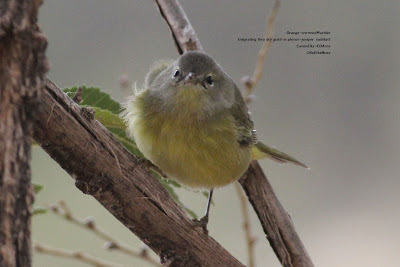
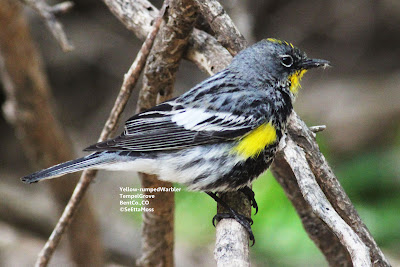
I was surprised to find the Orange-crowned Warbler shown above and several Yellow-rumped Warblers including the one below in the same dry gulch/wash where I have found migrating sapsuckers. I think many if not most of us associate riparian areas, and other places with water (or parks,etc where irrigation is done) as locations where warblers species are found during migration. It does make some sense that dry gulches/washes might be suitable migration corridors for at least a limited number of warblers since these areas catch most of the water that runs off during storms so they provide the most healthy trees and shrubs, and a higher likelihood of insects and small fruit that they might eat. I returned today and saw one Orange-crowned Warbler and a few Yellow-rumps, likely the same birds from yesterday that are using this area as a migration stop-over as they follow the dry gulch/wash down from their higher elevation breeding areas (6,500 to 9,500 per Colo Breeding Bird Atlas I...

Bright spring plumaged Yellow-rumped Warbler

Image
Yellow-rumped Warblers can have such bright colorful plumage during spring as this Audubon's sub-species has. This is one I saw at Tempel Grove in Bent County,CO. SeEtta