Posts

Showing posts with the label Olive-sidedFlycatcher

Olive-sided Flycatcher migrating through south central Colorado

Image
8-14-16 correction--I stated below that landbird migration had begun but this was corrected by the following post on Cobirds listserv by Tony Leukering: >> I spotted this Olive-sided Flycatcher this afternoon as it sallied out after insects at Brush Hollow State Wildlife Area just over 10 miles northeast of Canon City. Since this species does not breed in this lower elevation it has stopped over to feed on it's migration south. With indistinct wing bars it appears to be an adult bird with worn plumage ( Sibley says they do not molt until they are on their winter grounds so adults have feathers almost a year old). Like many/most fall flycatchers it was silent but it's clear vested underparts, big head and short tail make it easy to id as an Olive-sided. Landbird migration has begun. SeEtta

Olive-sided Flycather video clip with it calling and singing

Image
This is one of more than a dozen Olive-sided Flycatchers I have seen in the Canon City area over the past 3 days while rainy and overcast weather conditions brought this and other neotropical migrants down and effectively grounded them here. This was way more than I have ever seen during migration in the past (usually no more than a couple of them). The top pic shows well the large head and 'vested' appearance that is a significant field mark for this species while the second pic shows the short tail but does not show the white tufts on the sides of it's rump that I saw in the field. I think that third pic best shows the large bill found on this species. While I heard the 'quick 3 beers/free beer' song from several of these flycatchers this one sang it's 'free beer' song and gave it's 'pip,pip,pip' call frequently that I picked up in this short video clip. Interestingly 'Birds of North America' online indicates they sing wh...

Apparent family group of Olive-sided Flycatchers in mountain area of Colorado

Image
I found an apparent family group of 3-4 Olive-sided Flycatchers on Thursday just southwest of Salida where the coniferous forest was edged by a deciduous riparian area at about 8,000 feet in elevation. There were at least 3 and maybe 4 Olive-sided Flycatchers and to have that many in one location would seem to indicate this was a family. Additional at times more than one of flycatchers perched near each other on a branch of one of the large cottonwood trees. Since it was late in the afternoon the lighting was poor plus the birds either perched high above or at a distance. The following information from Birds of North America online leaves open the possibility that the birds did not nest in this location: "Fledglings typically observed with adults on territory 10–15 d after fledging, but reported with adults near the nest up to 17 d (Wright 1997) and 19 d (Altman 1999) after fledging. Mearns (1890) suggested that family groups stay together until fall migration, and those ...

Olive-sided Flycatcher, still declining in numbers

Image
This Olive-sided Flycatcher was an unexpected surprise on my trip to the Lower Arkansas Valley of Colorado last week. I found it giving it's 'quick free beer' call in the limited forest edge around Lake Holbrook. The top photo is really such a classic view showing it's distinctive dark vest an it's very short tail. The is a species of concern with continuing significant population decline. The tufts of white feathers on it's rump, another feature of this species though not always visible, can be seen in fluffed up bird in the bottom pic. SeEtta

Strange view of Olive-sided Flycatchers

Image
While birding on the Canon City, CO Riverwalk last week-end I spotted 2 large birds at the top of a tree over the trail and the top pic is what I saw--it took me a minute to realize that this was an Olive-sided Flycatcher from a bottoms-up view. Given their location, the bottom 2 pics were the best I could get of these birds. I was surprised to see the light yellowish wash on the belly area when I enlarged the pics as they are usually not close enough to see this in pics and I don't think I've ever seen in in binoculars. I did check and Birds of North America online which said: "Whitish belly sometimes has pale-primrose-yellow wash." I ran into 2 Olive-sided Flycatchers just about an hour ago and at the same location on the Riverwalk (same birds??? maybe using this as a stop-over location to fuel up for the rest of their migration journey). This time they were calling though all I could hear was the 'three beers' part of their 'quick three beers...

More new arrivals on the Canon City,CO Riverwalk

Image
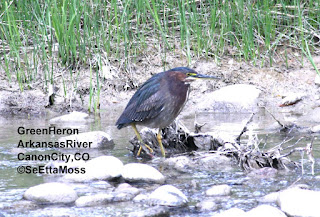
The Green Heron in the top pic was feeding at the outfall of a stormwater pipe where it flows into the Arkansas River across from the Canon City, CO Riverwalk. There were also several Yellow-rumped Warblers feeding by sallying and even picking insects from the rocks at this same outfall. The Olive-sided Flycatcher was next to the Riverwalk bluff trail. And the Indigo Bunting was in the same area. It is always good to see Olive-sided Flycatchers as their numbers are dwindling. It was very overcast when I photographed the flycatcher and bunting so their pics are darker than the heron which had some sunlight to brighten that pic. SeEtta

Landbird migration--Olive-sided Flycatcher

Image
More fall migrants are moving through the Canon City, CO area where I live including this Olive-sided Flycatcher I saw this morning on the Canon City Riverwalk. Olive-sided Flycatchers migrate the furthest of all the flycatcher species that breed in North America. Sadly, Olive-sided Flycatchers are a species of serious concern due to continuing declining numbers. One of the Cornell Univ websites, Birds in Forested Landscapes, says that they have experienced an "overall loss of 67% has been noted since 1966." SeEtta