Posts

Showing posts with the label ProbableBlackXEasternHybridPhoebe

Phoebes-Day 16 post fledging

Image
Today I saw the last of the young from the phoebe family I have been following flying after insects by itself for awhile. After awhile, a parent bird appeared though I didn't see it feed this young bird which is pictured above. Later I saw a third phoebe, another bird in juvenal plumage, come near to the other two phoebes so I expect it is one of the other young that gained independence but came back here as it is a very good feeding area (and maybe it thought it could get a meal from the parent bird?). This other young bird looked like the photo below which I took yesterday of the second to last fledgling to become independent. SeEtta

At least one fledgling still being fed

This morning I stopped by briefly to check on the phoebe fledglings progress. I only saw one fledgling, one that I believe to be slightly but noticeably larger than it's siblings (I know, they all look alike but I have been observing dozens of phoebes over the years and some for weeks on end, and I have found that many do have plumage that is subtly different). It was located near the nest site and appeared to be alone. It flew out after a number of insects with only occasional success. After a time the adult bird appeared, caught an insect which it fed to the fledgling--again the adult is supplementing the fledglings food but letting it practice. This evening when I returned to my friend's place to walk my dogs at dusk, as soon as I parked my car I heard 'tseep' calls (the calls these probably hybrid phoebes, as well as Black Phoebes, make). A parent phoebe and one fledgling were sallying after insects from a structure next to the Arkansas River (and one of the go...

More info on phoebe family

Though I got some video, I had a meeting for which my Audubon chapter has conservation concerns so I haven't had time to edit and upload it. But I wanted to get some additional info out about this probable hybrid phoebe family. While I watched yesterday morning, the parent bird fed each of the two young for 5-10 minutes. Then the adult flew to the opposite sided of the Arkansas River quickly followed by the apparent fledglings (since they aren't independent yet, they are still fledglings). The adult flew out a number of times capturing insects in this area. After a few minutes, the adult flew to another location on the south side of the river where it sallied out and caught a number of insects. Each of these locations are places along the Arkansas River where I have seen many previous phoebes feeding and I associate them as good feeding locations--it would seem that this adult bird does also. A short time later one of the fledglings returned to the spot near the nest sit...

Phoebe young still being fed!

Image
After losing track of the phoebe family for several days and thinking the young were independent with each one moving on, I was surprised to find a parent with 2 young phoebes yesterday right next to the location where they nested. And I was more surprised to see the parent feeding each of the young birds--these young phoebes were now 15 days from fledging! This surprised me as the Black Phoebes (at least both parents appeared to be Black Phoebes and not in intermediate plumage as one of these parents) that I have followed in the past have caught their own food much earlier than this. However, since these are apparent hybrid BlackXEastern Phoebes, I checked Birds of North America online and found that the little documentation they have on Eastern Phoebes indicates they may be fed by parents up to 14-17 days post fledging. This source had little info on young Black Phoebes but there is evidence that young of this species will start making 'foraging flights' during the first...

Probable hybrid phoebe with very unusual plumage

Image
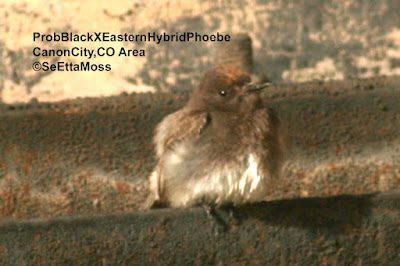
I found this probable Black/Eastern Phoebe hybrid today at my friend's in the Canon City,CO area. It has bright brown, almost rust colored, forehead feathers. The dark body feathers are from dark brown to charcoal and it has a breast dark on the top and white beneath, separated by an inverted 'v' found in Black Phoebes (as it's feathers were ruffled in the pics, I cannot tell how close to a 'v' this is). Again not possible to tell for sure but it looks like it is undergoing a molt of some side and back feathers. It called only once, a 'tseep' that sounded like a Black Phoebe. It interacted briefly with another phoebe (probably a Black Phoebe but I didn't see it good enough to rule out another hybrid) in an neutral manner. SeEtta