Posts

Showing posts with the label FemaleWilliamson'sSapsucker

Williamson's Sapsucker in mid-winter in Red Canyon Park

Image
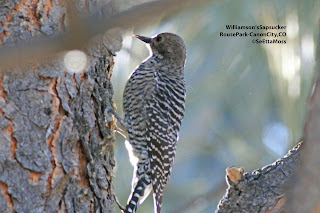
I drove up to Red Canyon Park yesterday morning and walked too close to a tree with this female Willamson's Sapsucker who flushed literally over my shoulder. She is so well camouflaged I had no idea she was in the tree until she flew out. I have in the past noticed hundreds of sap wells drilled by sapsuckers in the pinyon and juniper trees in Red Canyon Park just north of Canon City but though I have birded there in spring, summer and fall I have never spotted a sapsucker in the park. Since I found the first Williamson's Sapsucker in Canon City in the winter more than a decade ago many sapsucker have been documented overwintering in the Canon City area, a few other areas in the region, while most migrate south to New Mexico or further for the winter. Though one bird does not confirm that this species overwinters in the pinyon juniper habitat of this park, it certainly seems most likely. She returned a short time later and I watched her drilling into the deeply pockete...

Williamson's Sapsuckers-first birds of the fall in Canon City

Image
Williamson's Sapsuckers breed in the mountains in Colorado and most apparently migrate south with all but a few birds reported in the state from Oct 1 to around April 1 when they start returning. Some of those remaining in Colorado come into Canon City in the fall and remain over the winter along with a few Red-naped and Yellow-bellied Sapsuckers. I found this male and female Williamson's Sapsuckers, the first of the season, in Lakeside Cemetery. Though they briefly fed in the same tree and near each other, it did not last long as the female left the tree to the more dominant male. I have observed this previously with males being more dominant and chasing females away from their feeding location. Though I have looked every day I had not refound any Williamson's until today when I spotted a male, likely the the one in these photos. SeEtta

Female Williamson's, dressed for blending in

Image
Female Williamson's Sapsuckers are not boldly plumaged like their male counterparts. Like in many bird species, females of this species have plumage that blends in with it's environment which is important so when they are nesting they do not draw too much attention to themselves (and where their nest site is located) by possible predators. SeEtta

Sapsuckers migrating via dry washes in Colorado?

Image
In the fall of 2010 I found and followed several Williamson's Sapsuckers drilling sap wells in a complex of siberian-type elm trees south of Canon City that were in a dry gulch/wash located in pinyon juniper habitat. I noted some thoughts at that time that they these sapsuckers, that breed in conifer forests and especially aspen stands at higher elevation (7,000 feet+) in Colorado, might be using these dry gulches/washes for migration. Last year was a poor year for Williamson's Sapsuckers around Canon City but this year got off to an early start when I found 2 males and a female in Lakeside Cemetery on August 28, a good month before I have previously seen this species here. Since then I have found several more Williamson's in the area including the these in the top two pics here that were on the siberian-type elm tree (only 2 trunks as much of the complex was destroyed last year) in the dry gulch/wash where I found them 2 years ago. And yesterday I found the R...

Williamson's Sapsucker-surprise in CanonCity in August

Image
I decided yesterday to look in Lakeside Cemetery to see if any migrating landbirds might have decided to go through there since though there is no lake there is frequent watering of vegetation and lots of trees. I did see a Cassin's Vireo in the canopy of some mature cottonwoods, an insect eater I thought might find this area more productive during our continuing severe drought. However I also found this female plus 2 male Williamson's Sapsuckers, a species that comes to Canon City in fall and stays to late winter. I have never seen them this early here though Birds of North America online states, " In s. Colorado, birds move down-slope in late Aug and early Sep...." More to come. SeEtta

One more Williamson's Sapsucker

Image
Double-click on this and the other sapsucker pics I posted today for super close-up views. This is another female Williamson's Sapsucker that I refound. This close up came out very nicely. Be aware that my digital camera and lens set-up provides the equivalent of about 900 mm in telephoto view--that's about 18X's the normal view. I took the photo from my car and left quickly without flushing the bird though it did stop feeding for about a minute when it heard my camera sounds. SeEtta

Wintering sapsuckers in Canon City area: Williamson's Sapsuckers

Image
Today I found both a male and a female Williamson's Sapsucker in the town of Florence as well as 4 female and 2 male Williamson's Sapsuckers in Canon City including this female. I was surprised just how different these three pics of the same sapsucker look--I took all within one minute but the sun really made a difference in the lighting. In the bottom pic it appears, when the pic is super enlarged, that there is a small bubble at the end of the bird's bill--or maybe it's just a drop of sap?? SeEtta

Wintering sapsuckers in Canon City,CO: an update

Image
Before I was out of town for a month on my Rio Grande Valley trip there had been up to 23 sapsuckers wintering in the Canon City area. Since I returned home I have only been able to locate 11. I took the top pic of a female Williamson's Sapsucker today at Rouse Park, a city-type park. I took the middle pic of another female Sapsucker earlier this week at a private residence. I also refound a male Williamson's at this private location which was hosting both a male and female of this species in November and December. SeEtta

Sapsuckers today: total of 19 in Canon City, CO Area

Image
I started off to just do a count of the female Williamson's Sapsuckers today as there are so many birds it seemed like it would be easier to just count the males and females on different days, but shifts in sapsucker locations changed my plan. The first sapsucker I spotted this morning at Centennial Park was a male, the first time I have seen a male at this location this year. Then I realized there were two sapsuckers in that same pine tree, one a male and the other a female. Sapsuckers do not like to share. The male proceeded to behave aggressively towards the female-he raised his crest and moved towards her, and get this--he gave a churr call then what sounded like he hissed at her. I was only 20-25 feet away so I could hear the interaction fairly well and it sounded like a hiss. (Of course, I can't find anything in the literature about such a sound by this species though I did find that young Red-headed Woodpecker nestlings do hiss.) Anyway, this caused the female to retreat...

Williamson's Sapsuckers-feeding on elm in dry wash in p-j area

Image
As I noted in last night's post, I saw a male and 3 female Williamson's Sapsuckers in the location just outside of Canon City where I had previously seen just 1 male and 1 female Williamson's. I got these pics of one of the male and of one of the females. It is really different to see them in these non-native and invasive eurasian elm trees but they certainly seem to enjoy feeding in/on (?) them as they continued to return to these deciduous trees after chasing each other into the pinyon-junipers that surround them. SeEtta

Williamson's Sapsucker-shy girl

Image
This is the third female Williamson's Sapsucker I found today in Centennial Park. She was pretty shy as she peaked around the tree or put herself behind small branches that obstructed her view until I caught this view (blurred by some pine needles). It does provide an intimate view as she takes a brief break from feeding. SeEtta

Williamson's Sapsuckers-3 feeding in Centennial Park today

Image
This morning I found 3 female Williamson's Sapsuckers in Canon City's Centennial Park today including the one in this pic. Two were feeding in pine trees less than a hundred feet apart. With the 2 other female Williamson's I saw today, there are at least 5 female Williamson's in Canon City which is a high for this species here. I have pics of one of the other females and 2 males I saw today that I will post next (I didn't get pics of the other females). SeEtta

Williamson's Sapsucker-female in Centennial Park in Canon City

Image
This female Williamson's Sapsucker has apparently been working the pine trees in Centennial Park for the past several weeks. I have seen a female in this and two other pine trees plus have seen active sap wells in several other pine trees in this park. SeEtta

Williamson's Sapsucker-female in Canon City cemetery

Image
The Canon City, CO sapsucker-fest continues with Williamson's Sapsuckers taking the very big lead--currently at least 4 females and 2 males in various hotspots in town. I have seen this female in the same pine tree in Lakeside Cemetery on several occasions over the past several weeks. The bottom pic catches this lady with her beak in a sap well. SeEtta

WinterSapsuckerFest in Canon City, CO--(Another) Williamson'sSapsucker

Image
I was able to get a little better pic, albeit a back view, of this Williamson's Sapsucker, that I have added as the top pic. Today I also found this female Williamson's Sapsucker in Canon City,CO today, but this one was feeding in the pines at Centennial Park, another location that has hosted wintering sapsuckers over the past 6 years. This female was high up the tree and quite shy so the pic is not as good as some of the other sapsucker pics. SeEtta

WinterSapsuckerFest in Canon City, CO--Williamson'sSapsucker

Image
Canon City, CO has hosted wintering sapsuckers every year for the past 7 years when I found the first one, also a Williamson's, on the grounds of the Abbey (a former monastery and Catholic boarding school with a large campus that has hundreds of trees of diverse species). I found the female Williamson's Sapsucker in these photos a week ago in the same location on the Abbey grounds as most of the sapsuckers that have previously wintered in Canon City. Williamson's Sapsuckers generally migrate south to winter in New Mexico and down into Mexico. I included the bottom pic because it shows some of the underside of this sapsucker including a small amount of the pretty lemon yellow belly that distinguishes this species.  Also the black breast band found on adult female Williamson's.  More sapsuckers in following posts.  SeEtta