Posts

Showing posts with the label Mission-TX

Roseate Spoonbill

Image
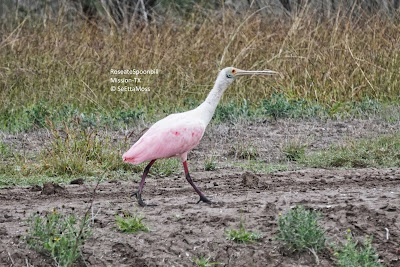
I found this Roseate Spoonbill walking along a canal at the Mission Nature Park. "Like many other bird species with beautiful plumage, roseate spoonbills were nearly hunted to extinction during the 1800s. Their striking pink feathers were popular on women's hats, and hunters from all over the United States competed for spoonbill plumes. In the early 1900s, roseate spoonbills began to recolonize areas along the Gulf Coast and slowly increase in number. Today, threats to roseate spoonbill populations come as a result of habitat loss." (from Texas Parks and Wildlife website) SeEtta

Hook-billed Kites: a dark morph from Thursday

Image
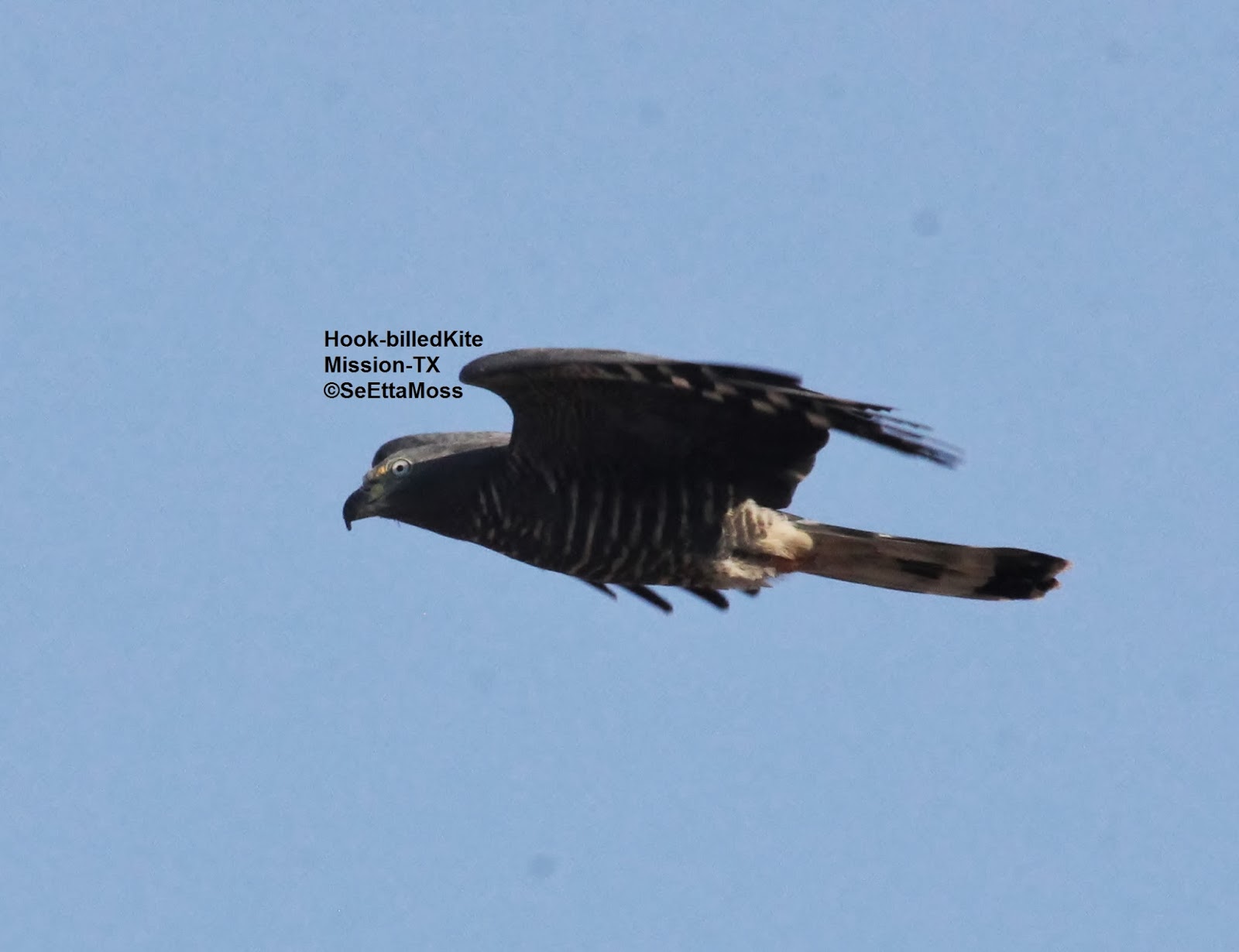
This was another Hook-billed Kite I photographed on Thursday near the Mission Nature Park.This one is an adult dark morph, the small amount of white showing on the basal area of the tail may indicate this a female (Bill Clark said that the black plumage is dull matte on females, a subtlety of plumage I don't feel comfortable assessing).    SeEtta

Hook-billed Kites: an adult female light morph seen today

Image
Today I returned to the Mission hike & bike trail area to look for the Hook-billed Kites again. I met Benton Basham there and a little later Bill Clark (raptor expert and book co-author)also showed up to took for the kites. I spotted a Hook-billed Kite fly in and land in a tree a couple of hundred feet away from us.  After it perched for a few minutes it flew off.  A little later Bill Clark spotted a second bird. This adult female light morph Hook-billed Kite flew in good light providing these good views.   The rufous hindneck collar can be easily seen in the bottom photo. SeEtta

Hook-billed Kite: adult female light morph

Image
This is a adult female light morph Hook-billed Kite that I observed and photographed yesterday near the Mission bike trail as it flew back across with 2 other Hook-billed Kites during the 3rd fly by. Most outstanding is her much heavier banding than the adult male I posted below. Wheeler in his Raptors of Western North America describes the head of adult female light morphs as follows: "Gray forehead with a gray area above and under the eyes." (p.78)--these features can be seen in the first photo. He also says they have a black cap and this can also be discerned in that first photo. Wheeler says the upperwings are 'dark grayish brown'. He further states, "Whitish underside of all remiges are distinctly barred with dark brown and have a wide dark ban on the trailing edge." (p.78) Those features are seen quite well in several of these photos. The females wide grayish tail band in mid-sectio can be seen on the upperside of her tail best in t...

Hook-billed Kite: adult male light morph perched in a distant tree

Image
Not the best photo of a Hook-billed Kite but the best I could get with it perched about 250 feet away with branches in the way. SeEtta

Hook-billed Kite-my life bird and one of 5 today in Mission,TX

Image
After spending 2 hours with more than 20 other birders this morning watching for Hook-billed Kites, that have been reported for several days flying in the area of the Mission, TX bike trails (Nature Park area) I returned in mid-afternoon to give it another try. I didn't see anyone else there when I arrived but quickly spotted 2 Hooked-billed Kites flying low coming in my direction. I heard some chattering vocalizations during that first flight as they had been flushed according to a couple from New York that had seen them further east of me. One of the Hawks landed in a tree in the mesquite forest about 250 feet away. I watched it for a full 5 minutes (per photo time stamping) where I got a very nice view through my spotting scope of his face including the "yellow teardrop over the eyes" (as described by Brian Wheeler in Raptors of W. North America). After both of those kites had flown off I stayed put and was delighted to watch between 1-3 birds fly by (al...

Another Gray Hawk, but much closer this time

Image
Yesterday I planned to drive into the La Lomita Church (a local historic site) park where my dog, Chase, can run around off leash usually as there are usually no one else there. And it's a pleasant place to do a little birding for a few local specialties. As I drove towards the park I spotted a small hawk on a post in front of the entrance--it was this Gray Hawk. I angled my car a little further so I could take photos of the hawk from inside my car to minimize disturbance. Doggone my Canon 60d dslr camera-even with all the bells turned off it still makes a clicking noise when I take photos and the hawk appeared to hear them and flew up into the trees. Fortunately I was able to carefully drive to a position where I could take these additional photos using my car as a photo blind.  SeEtta

Guatemalan Leafwing, yet another tropical visitor

Image
While I was focused on getting good photos of the Pavon Emperor butterfly yesterday, there was another butterfly feeding next to it. As I have enough trouble with butterflies that are intact, I didn't pay much attention to it. But Mike Richark, one of the skilled butterflyers who was helping me to see some of the fine butterflies at the National Butterfly Center realized this was not a less rare leafwing. Like the other tropical butterflies I have posted this one 'strays' to the Lower Rio Grande Valley of Texas as this one has done, albeit without part of it's wings. (get a close-up view by clicking on this pic but please note there is a shadow of a branch that runs vertically across this pic) SeEtta

Angled Leafwing, another tropical butterfly

Image
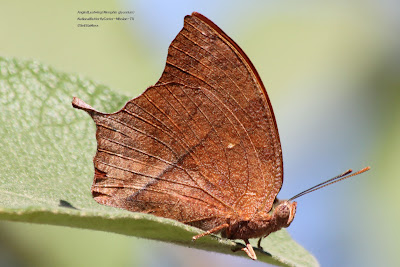
Another tropical butterfly that strays into So Texas, this Angled Leafwing's range is from northern So. America north through Mexico according to Butterflies and Moths of North America. I saw my first of this species yesterday at the National Butterfly Center but wasn't able to get a photo. Today's nice sunshine allowed these nice photos--so nice all I did was crop them. Like all but the Malachite that I was able to id on my own, some friendly and skilled butterflyer's pointed this out to me. This butterfly's eyes are pretty cool and can be seen up close by clicking on the top pic. SeEtta

Pavon Emperor, other views

Image
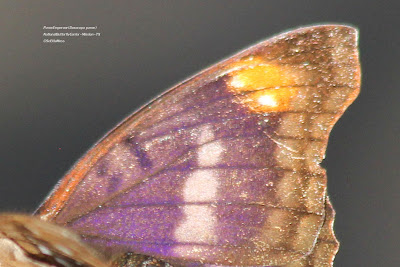
I thought this close up view of the wing of this male Pavon Emperor showed off it's iridescence. And the photo below demonstrates the importance of angle of view which provides the refraction of light that is necessary to show off it's color (or, as shown, not show the color). This is a phenomena also found with the plumage coloration on some birds. SeEtta

Pavon Emperor butterfly again today

Image
Having been told by some of the experienced butterflyers that the forecast sun today would bring more great butterfly action I returned to the National Butterfly Center for an enjoyable Christmas morning (and a little bit of afternoon too). I was told that the Pavon Emperor had not yet been seen. Ah, beginner's luck (and the fact I spent a bunch of time with that butterfly yesterday), I refound it. And today's sunshine allowed me to get some great photos that showed the iridescent bluish purple found on males of this species--what a gorgeous butterfly it is! (note: I was careful to maintain the natural colors and did not enhance them). SeEtta

Pavon Emperor butterfly, another view

Image
This gives a nice ventral view of this rare visiting butterfly. In this one it's proboscis is rolled back up. Interestingly there are two additional green appendages visible on both sides of it's head (or neck?) that can be seen in this pic. I searched the internet some but couldn't find anything about these. SeEtta

Pavon Emperor, rare tropical butterfly

Image
I was very fortunate today to visit the National Butterfly Center in Mission, Tx when a rare tropical butterfly was being seen. I never heard who found this butterfly (apparently found here before today and refound today) whose range is from Bolivia in South America to northern Mexico according to Butterflies and Moths of North America . I am a rank novice who was the beneficiary of others who alerted me and others to this rare find and showed it to us. One more neat photo in next post. It has a green proboscis which is shown in these pics. I'm sure that someone told me this is a male but it looks more like the photos of female Pavon Emperors. I will have to find that out to be sure. SeEtta

Hummer-still pics--[Post note: probable Black-chinned]

Image
[POST NOTE: I have requested and received feedback from several members of the Texbird listserve, including those with considerable experience and expertise, that all agreed this is not an Ann's Hummingbird. They all also agreed that it is, or it is suggestive of, a Black-chinned Hummingbird.] Not the best pics but these may provide more clues for an identification. Double-click on each pic for enlarged views. SeEtta

Hummingbird--video clip 3-[Post note: probable Black-chinned]

[POST NOTE: I have requested and received feedback from several members of the Texbird listserve, including those with considerable experience and expertise, that all agreed this is not an Ann's Hummingbird. They all also agreed that it is, or it is suggestive of, a Black-chinned Hummingbird.] This clip provides a good and close view of the hummingbird's back. SeEtta

Hummingbird: another video clip-[post note: prob Black-chinned]

[POST NOTE: I have requested and received feedback from several members of the Texbird listserve, including those with considerable experience and expertise, that all agreed this is not an Ann's Hummingbird. They all also agreed that it is, or it is suggestive of, a Black-chinned Hummingbird.] Though this hummingbird holds it's tail still at times, at other times it pumps it as is shown in this clip. There are groups of feathers with color (that is not clear in this clip) on it's whitish breast that can be readily viewed when the video is stopped briefly. SeEtta

[Prob Black-chinned ] Hummingbird at Bentsen Palm Village RV Park in Mission,TX

[[POST NOTE: I have requested and received feedback from several members of the Texbird listserve, including those with considerable experience and expertise, that all agreed this is not an Ann's Hummingbird. They all also agreed that it is, or it is suggestive of, a Black-chinned Hummingbird.] I videotaped this female/immature hummingbird in the Bentsen Palm RV Park in Mission,TX feeding in the same coral bean tree as the Black-vented Oriole (and while that rare vagrant was off somewhere else). Another birder said he believed this was an immature Anna's Hummingbird which would also be fairly rare for this area in the winter. Unfortunately I have very limited experience with Anna's Hummingbirds, including none with females and immatures. This bird looks more like a immature Black-chinned but I thought I should put this and more video clips up for feedback by those familiar with Anna's. SeEtta