Posts

Showing posts with the label Lewis'sWoodpecker

Lewis's Woodpecker, most vibrant woodpecker

Image
I have followed Lewis's Woodpeckers in Canon City for many years as they seemingly come and go from various locations around the area. Last year I couldn't any around town so I have pleased to find a few near one of the many orchards in this area.  They are a species of conservation concern due to habitat loss including competition for nest holes from Starlings.  I love to watch them as their salmon colored underparts are brilliant when the sun hits them.  SeEtta
Lewis's Woodpecker in fresh bright plumage

Image
I was happy to find this Lewis's Woodpecker in such fresh plumage especially since the last one photographed, just a few weeks ago, was very rugged looking in it's molt. While backshots are not often posted I think it is helpful for some birders to learn how birds look from behind since sometimes that is the only view one gets. On this species the wide silver-gray collar is distinctive. The sun hit the face of this bird and it's bright raspberry face really popped out. The greenish back that so often looks black in photos looks more greenish with the sunlight.   SeEtta

Rugged looking Lewis's Woodpecker

Image
After an absense of almost 2 years from the Canon City area, I found a flock of Lewis's Woodpeckers have returned. I have no idea where they have been as I have checked the 3 reliable sites in and near town for them most of 2016 and this year with no luck. Previously they had been quite regular for much of the past 10 years. This is molt time for this species and this one does look rather disheveled. SeEtta

Lewis's Woodpecker

Image
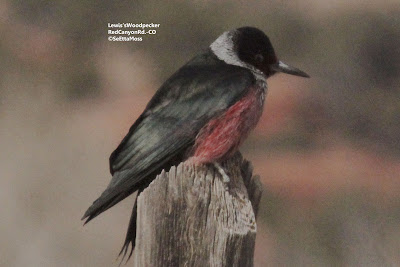
I found this Lewis's Woodpecker north of Canon City day before yesterday. I think Lewis's Woodpeckers are pretty cool looking but it's hard to get their colors to show unless the light is just right--it was almost right this time but the red on it's face didn't show. SeEtta

Lewis'sWoodpeckers: view of adult from below and a juvenile

Image
As I noted in last post the Lewis's Woodpeckers landed in a snag almost directly above me and that produced the top pic, a view from right underneath this adult bird. This provides a very nice view of the undertail coverts as well as the underparts and the tail feathers from below. The bird in the bottom pic is one of this year's hatch evident as it is in juvenal plumage and it is late summer. Though not real apparent, it does have some reddish feathering on it's breast and belly.   It should begin moulting into Basic I plumage this fall. SeEtta

Lewis's Woodpeckers: return to nest site area

Image
It is my experience that after the Lewis's Woodpecker young fledge the parents move them quickly away from the nest site as soon as their flight skills allow, likely to reduce predation which is reported to be heavy by American Kestrels (per Birds of North America online ). So I haven't seen these birds for two weeks since they were still in the nest until this morning when the parents brought them back while foraging. I got some close views (30-40 feet from me, close for this species) as they landed in a snag almost directly above me. In order not to flush them I stayed in my car and took these photos out the car window-which required uncomfortable positioning that would have been easier to do when I was in my 20's. SeEtta

Lewis'sWoodpecker: nice tail views

Image
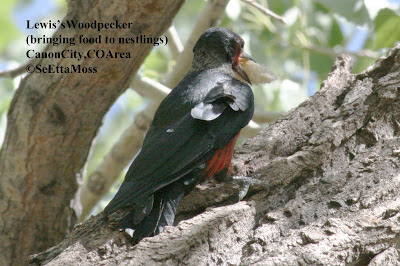
Just two last pics of this Lewis's Woodpecker bringing food to nestlings that give nice views of the tail. Woodpeckers have very stiff tail feathers that they use to help anchor them to provide stability when engaged in drilling. "The bending stiffness of woodpecker tail feathers is especially high. . . It is this feature that makes them good for bracing the woodpecker against the forces of pecking." (page 9) SeEtta

Lewis'sWoodpecker: is this food white bread?

Image
A former entomologist with the Colorado State Forest Service emailed me that this food item is not an insect or larvae. He said he thinks it is bread. Since the nest is about a quarter mile from two homes plus farm workers in nearby fields may drop white bread, it would certainly be feasible for this Lewis's Woodpecker to opportunistically appropriate some bread thinking it would be easy-food for the nestlings (though likely not a source of much nutrition for them). In the pics showing this food, it certainly has a strange consistency. For much closer views of this food just click on each pic then click on them again. SeEtta

Lewis'sWoodpecker: nestling sneaking a peak

Image
In the top pic the nestling has reached it's bill up to receive food (white stuff) from the parent Lewis's Woodpecker (it's bill is just to the right of the arrow). The bottom pic shows a nestling sneaking a peak between visits by the parent to the nest hole with food. This is first time I have ever seen a nestling Lewis's Woodpecker so I was very excited when I saw this pic in my camera's lcd viewer. The nestling has a hint of the strawberry coloration on it's lower face plus the gray/silver coloration on the neck area that is so distinctive of adult birds. The hatchlings fledged had fledged when I returned 2 days later. SeEtt

Lewis'sWoodpecker: feeding nestlings

Image
The Lewis's Woodpecker is in the process of feeding nestlings inside the nest hole in both of these pics. In the bottom pic it had turned it's back to me so this is a tail-end view of the bird as it inserted it's head into the nest hole. SeEtta

Lewis'sWoodpecker: bringing food to nestlings

Image
This is a parent Lewis's Woodpecker at the nest hole I found recently. In the top and middle pics this bird has some very good size white-colored food it has brought to the nest tree. I believe it is some kind of insect, or extra large larvae, as I could discern what looked like a couple of legs sticking out from it--I would love to find out if anyone could identify it. (this can be viewed close-up by clicking on each pic then clicking again on enlarge pic) After it flew to the next to the nest hole with the large food item, this woodpecker deposited it in crevice in the tree bark then proceeded to pound on it with it's bill. The bottom pic is when the bird rested during this process and it shows some of the food attached to it's bill--I suppose it was killing it then maybe breaking it into smaller pieces as it proceeded to take small pieces to the nestlings. More to come. SeEtta

Lewis's Woodpeckers

Image
On my way back from the Denver area I stopped at Ft Carson's Turkey Creek Ranch where I saw 3 Lewis's Woodpecker including the one in these pics in a remnant cottonwood gallery. I just love the unusual green and reddish coloration on these woodpeckers. SeEtta

Lewis's Woodpecker juveniles-video clip 2

This clip gives a nice view of the juvenal plumage of these Lewis's Woodpeckers including a good look at the of the warm chesnut tones on it's head. According to "Birds of North America" online there is considerable variation in juvenal plumage in birds in these post-breeding flocks but does note that "feathers of hindneck have white subterminal spots (not present in adult....)"--these white spots can be seen if the video is stopped when it's back is to the camera. BNA also notes that the tail feathers are more pointed than in adult plumage a feature seen at the end of this clip. One of the woodpeckers flies over to the top of a snag and has what looks like a winged insect in it's bill. It proceeds to either cache this food or try to dig more insects out? I have watched this clip over and over and cannot tell whether it is food caching or finding. This species is known for caching acorns in tree crevices (tho I didn't find anything about them ca...

Lewis's Woopecker juveniles-video clip 1

I first found these Lewis's Woodpeckers in juvenal plumage on Aug 13 flying from branch to branch on the likely nest tree. However, they flew across the river before I could count how many there were or see if they were still being fed by parents. I refound them on Aug 21 just a few hundred feet from the probable nest tree and they were clearly foraging for themselves when I took this very short video clip. SeEtta

Nictitating membrane on Lewis's Woodpecker

Image
As noted in the post below, I took pics of this Lewis's Woodpecker today. In this pic, the woodpecker's nictitating membrane is over it's eye. The nictitating membrane is referred to as a bird's third eyelid. Bird's "blink" this nictitating membrane over their eye many times per minute and it apparently moistens the cornea. High speed photography shows that woodpeckers close this nictitating membrane milliseconds before striking it their bills, thus protecting the eye from flying debris and also serving to hold the eyeball in place (to protect from the shock of the strike). Read more about the research on this and protection for their brains here Double-click on the pic for a good close-up view of it's covered eye and also of it's tongue . SeEtta

Colorful Lewis's Woodpecker

Image
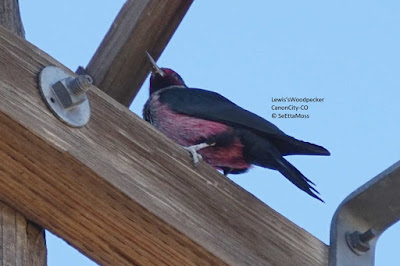
I have following a pair of Lewis's Woodpeckers that have a nest in a snag in a large cottonwood on my friend's property along the Arkansas River near Canon City. I have taken a number of pics of the adults attending the nest, but since it is in the tree it is quite shaded and the pics don't do justice to the beauty of these very colorful woodpeckers. Today I saw this woodpecker that had stopped on a phone pole while bringing food to the nestlings (I can hear them loudly now) where there was sunshine to bring out some of the colors. The beautiful red on the face and belly does come through pretty accurately in these pics as does the grey collar. Though the back appears black in these pics as it often does on these woodpeckers, the green gloss does not show through. The top pic shows the bird with it's eyes open (important comparison for next post). The bottom pic shows the bird with this large piece of unknown food that it subsequently takes to the nest after I took...

More Lewis's Woodpecker pics

Image
Here are two more pics of the nesting Lewis's Woodpeckers that I took yesterday. In the top pic, the woodpecker is entering the nest cavity. In the bottom pic, the woodpecker is getting ready to fly out of the nest cavity. The top pic appears almost artificial but the colors are natural and have not been modified though I did have to lighten the pic as the nest cavity is in the shade. Also the eyes are large and dark just as shown in the bottom pic. SeEtta

Nesting Lewis's Woodpeckers

Image
I found a pair of Lewis's Woodpeckers bringing food to nestlings in the tree cavity that is just in front of the bird in these pics. The nestlings must be older as the woodpeckers (both the male and female feed the nestlings) were making frequent trips to the nest cavity to bring food. I also saw them coming out of the nest hole with fecal sacks in their bills. SeEtta