Posts

Showing posts with the label Florence-Colo

White-faced Ibis shows off underwing feathering

Image
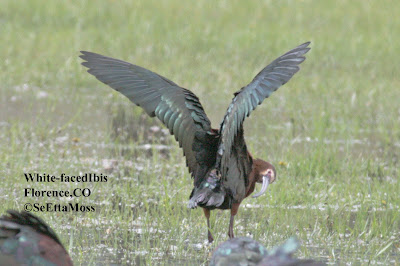
I can only think that this White-faced Ibis was trying to either dry off it's wings or engage in 'sunning' behavior as it lifted it's wing and spread it for a view of the underwing plumage not often seen. This bird's head feathers are standing out as though wet so it may have done some bathing in the water standing in the field. I did no editing other than to crop this pic either so the greenish tinge to the top part of the underwing is how these feathers appeared. SeEtta

Ibis flock pic & video clip and Glossy Ibis update

Image
href="https://blogger.googleusercontent.com/img/b/R29vZ2xl/AVvXsEiIYuzRGEbyCDbtD7tvBuxBvcgTPIbNmaUkmyHEyTFctMWYnnq2w3rL41_FmZFJYI8JY-zDJbLu0QfgLkEQRP_ozNQRPEHmTQBluMq5c0qR1Mi_PFw0t0NxEg8VlSgAabEaUjFOjDCMASI/s1600/IbisFlock-Florence.jpg" imageanchor="1" style="margin-left: 1em; margin-right: 1em;"> Pic at top shows several hundred Plegadis ibis as they fed in ag field. The video clip shows 200+ Plegadis ibis flying from one side of the field to the other where more ibis are feeding. The video is best seen in full screen view (click on the 4 arrows in lower right corner of screen) I have now gone through all the pics of ibis that I posted as Glossies. The 3 birds I identified as Glossy Ibis below (in post labeled 'Better pics of Glossy Ibis' and 'Two Glossy Ibises feeding near each other) all have blue facial lines that do not invade behind the eye. I believe that at least these 3 birds in the flocks I saw are Glossy Ibises though there ...

Two Glossy Ibises feeding near each other

Image
Though it is difficult to be sure that the Glossy Ibises I have photographed are all different birds it is clear that there are for sure at least 2 different Glossies as both are foraging in this pic. SeEtta

Another Glossy Ibis--apparently not!

Image
Post note: after posting this and sending a message to the cobirds listserve, I took some time to really check out the photos at big enlargement--I now see that there is a sliver of facial skin (looks bluish but hard to tell as it's so thin and doesn't matter) that goes behind the eye--this is not found on Glossies so this is apparently a hybrid. These two pics are of the same bird but I think a third Glossy Ibis feeding in the agricultural fields in Florence today. I can't be sure but I believe this is a different Glossy from the others in pics below, part of at least 4 different Glossies in this very large flock of Plegadis ibis. Seetta

Glossy Ibis with large worm--oops, apparently a hybrid with a large worm

Image
Post note: after uploading these and sending a message to cobirds listserve, I took some time to enlarge the photos further. When I did it was clear that there is facial skin behind this ibis' eye. Per Birds of North America online, Glossy Ibis have "a distinctive edging of pale-blue skin above and below but not continuing around eye,". So this is clearly a hybrid bird. This Glossy Ibis has a very large worm in it's bill--one of the yummy invertebrates that these birds forage for in these flooded fields. This is the only pic of ibis that I have edited (other than cropping) and I did so in order to make the worm more visible. SeEtta

Better pics of Glossy Ibises

Image
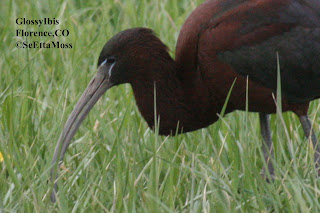
I drove back to Florence this morning to see if I could refind the Plegadis ibis flocks I found yesterday in hopes of photographing the Glossy Ibises in good light (last night it was overcast and late in the day so light was not good). I refound most of the 400-500 ibises in one of the same agricultural fields and got these pics. These are all pics of the same bird taken as it foraged in a field where the owner was irrigating. It has nice blue lines framing it's face and a dark iris. I did not do any editing of these pics (except pic in post above of bird eating worm) other than cropping so colors are not modified. Remember that to double click on each pic to enlarge it (and then click again to super enlarge it, tho this may reduce clarity) SeEtta

Very large flock of Plegadis ibis

Image
This photo shows much,though not all, of the Plegadis ibis in this one large agricultural field in Florence in which there were 300-400 ibis (to the far left there was a tight group of ibis that look like black dots in this pic so double click on pic to enlarge it and click it again, then look for more birds in far left corner) that was in addition to the first flock of over a hundred that I found. I was unable to check these ibis for additional Glossy Ibis that I found in that other flock. Awesome numbers! SeEtta .

Glossy Ibises

Image
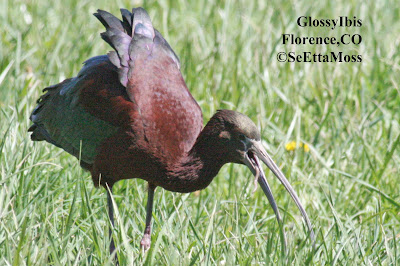
When I returned late this afternoon from an out of town meeting I drove through the agricultural fields on the edge of the small town of Florence,CO where I was rewarded with a flock of over a hundred Plegadis ibis. Many were foraging in this ag field that apparently had recently been flooded and others were napping. I watched a flurry of activity when one found some large juicy something in the field as several others tried to grab it. I spotted 2-3 Glossy Ibis in this flock. The top pic shows one with pretty blue lines framing it's face, a dark iris and darker blue-green gloss to plumage (I did not lighten or otherwise edit pic other than crop it to maintain integrity of colors). The bird in the foreground of the bottom pic is the same as the one in the top pic. The bird behind it, I believe an immature from the crown feathering, appears to also have blue facial lines and a dark eye. (This can be seen a little better by double-clicking on the pic and then clicking it again...

Put your wings up high, turn your head around & do the hokey-pokey

Image
Ok,ok, so the hokey-pokey reference ages me. But that's what this White-faced Ibis reminded me of as it took this unusual position at the end of it's bath.

Splish,splash-Ibis taking a bath

Image
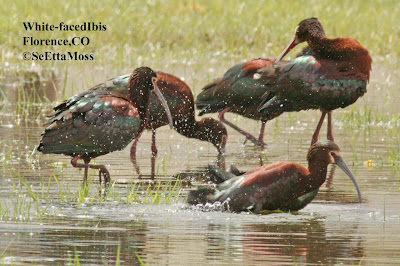
I found these White-faced Ibis, part of a flock of more than a hundred,in an agricultural field on the edge of the little town of Florence,CO where they still use flood irrigation which results in wetland/wet meadow like habitat that provides good a stop-over location during migration. It also provides the opportunity for a refreshing bath for these vigorous bathers, though apparently not as deep as the bird in the bottom pic (that almost laying down in the water) would prefer. Yes, those are water drops flying through the air due to the vigorous beating of wings and shaking of feathers. There was one Glossy Ibis in this flock, that would have made a beautiful pic with it's pretty blue lines framing it's face-but wouldn't you know I couldn't get it's photo. SeEtta

Yellow-headed Blackbirds arrive in Florence, CO

Image
There are few locations that host Yellow-headed Blackbirds in the Canon City,CO area but one of the dairies in Florence is a one of those locations where this species occurs regularly from spring to early fall. Like the Starlings and other blackbird species, the Yellow-headed Blackbirds comes to eat from the spilled grain and seed here. And they have a distinctive tail-held-high-up stance when feeding as shown in these pics. SeEtta

Evening Grosbeak invasion

Image
Known as an invasive species, Evening Grosbeak are living up to that descriptor as seem to be invading my area of Colorado. I have been hearing Evening Grosbeaks in my neighborhood in Canon City, CO for just over a week and have seen them high up in my neighbors tall trees. Today I found two flocks of Evening Grosbeaks feasting on the tender shoots in groves of deciduous trees in locations about a half mile apart. Though the winds were gusting strongly, these agile birds fed on branches that jumped up and down as though riding some wild carnival rides. The winds also made taking these photos challenging. SeEtta

Migrating pelicans-not an unusual site in many parts of Colorado

Image
American White Pelicans both migrate through and stay to breed in various parts of Colorado. Though they don't breed in my area, they do migrate through and often use our (few) local ponds as stop-overs as they make their way to South Park where they breed on 8,000 foot elevation lakes. I happened to be in Florence when this flock flew over. SeEtta

More migrating Wilson's Snipe: a photo study

Image
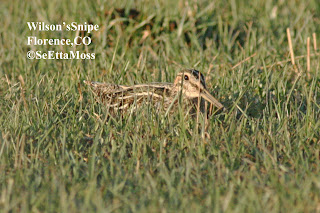
Here are the rest of the photos of the Wilson's Snipe I found in the flooded fields in Florence this week. I like the top one as it shows just how well this species can be camouflaged when lying down in a field. The middle two pics show the back plumage which is boldly striped and the short organge tail. The length of the bill is also clearly seen. The bottom pic shows off the bold stripes on it's head. Again, double-click on each pic to enlarge (and then you can click again to super enlarge the pics). SeEtta

Migrating Wilson's Snipe-a pictoral study

Image
Though I usually find Wilson's Snipe in the Canon City, CO area in most winters, I couldn't find any this past winter which though mostly warmer than usual had a significant cold spell with consecutive well below zero temps (more than 15 below). I suspect that the snipe in these pics migrated into the area this week. I found 3 Wilson's Snipe foraging together in the flooded fields in Florence a few days ago. They were sharing this area with migrating Lesser and Greater Yellowlegs and Snowy Egrets that I posted about below. The snipe in the middle two pics raised their tails after disturbed by a flock of Starlings and appears to be a defensive or agonistic behavior. In the bottom pic the snipe has it's wings raised up out of the way that shows well the extensive barring on it's flanks. Do double-click on each pic to enlarge them for close-up views. SeEtta

Snowy Egret with plumes blowing in the wind

Image
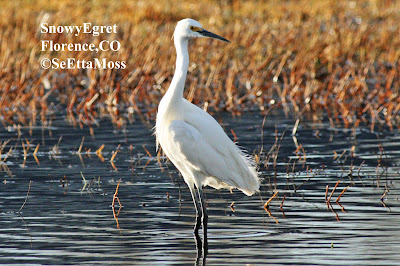
A few Snowy Egrets stop-over in the Canon City, Colo area during spring migration and only a few as wetlands and other bodies of water are in short supply in this area. A favorite stop-over spot is the agricultural fields just east of Florence where they still practice flood irrigation. When these agricultural fields are flooded with irrigation water they become like wet meadows and are ideal for waterbirds and waterfowl alike. This is one of several Snowy Egrets I have seen foraging in the Florence area over the past week. Since the wind is almost always blowing these days, it was easy to get photos of the Snowy Egrets plumes blowing in the incessant winds though the egret had just shook and fluffed its feathers that accentuated the effect in the bottom pic.  Both pics can be viewed by double-clicking on each pic to enlarge it. SeEtta

Greater and Lesser Yellowlegs, both in photo together

Image
Though most of the Yellowlegs that are migrating through my area of Colorado are Greater Yellowlegs, I did get this pic with both a Lesser and a Greater in the same frame that shows some of the differences in these similar species. The bill on the Lesser is much shorter relative to the size of it's head than the Greater. The bill on the Greater shows a slight upturn and though more distant in this pic, it is larger in size (tho a very difficult difference to judge in the field when Lessers not present). Also liked this pic of the Lesser Yellowlegs I photographed as it foraged in the flooded agricultural fields that become like wet meadows when flood irrigated. Both pics can be best viewed for details by double-clicking to enlarge each one. SeEtta

First-of-the-year Great Egret in Canon City,CO area

Image
Yesterday I also found this Great Egret, the first I have seen this year and the first reported in Fremont County, CO. It was feeding in the wetlands in a small park in Florence, CO which is less than 10 miles from Canon City. Much of the birding in Florence River Park crashed after the town cut out almost all the tamarisk, an invasive plant, which composed most of the understory to the nice cottonwood riparian area adjacent to the Arkansas River (instead of staging the removal and replanting native vegetation to provide continuing habitat for neotropical migrant songbirds that used to frequent the park). Fortunately they did not enter the wetland area of this park to go after tamarisk plants so it still draws some birds (though this is the first time I have seen a Great Egret in that wetland). SeEtta

First-of-the-year Greater Yellowlegs

Image
I found this first-of-the-year shorebird working in a flooded field in Florence, Colo with some Canada Geese and a few ducks. SeEtta