Posts

Showing posts with the label EsteroLlanoGrandeStatePark-TX

Rare for the LRGV, a Hammond' Flycather

Image
This Hammond's Flycatcher was identified yesterday at Estero Llano Grande State Park in Weslaco, TX by Mary Gustafson with some notes that this bird has been around for a month (I guess the bird matches some photos taken last month but identified as another species). There are very small differences between Hammond's and Dusky Flycatcher and similar to other empids. This bird wagged it's tail upwards which rules out Gray Flycatcher that wags it's tail downward. Sibley notes that Dusky has a rounded head and this bird shows a flatter head.  Sibley also differentiates Dusky and Hammond's by primary projection with Dusky having a short projection and Hammond's a long projection. Not visible in pics but I looked at the bird 's back and had the impression of a long primary projection. Sibley also states that Hammond's have a "distinct 'vest'" and all 3 of these shows a vested appearance. But I am glad there have been no other fl...

Baby Chachalacas, surprisingly cute

Image
When I first spotted these young birds climbing in the branches above I had no idea what species they were but the mystery was soon resolved as the nearby adult Chachalacas decided I was too close--so they began their raucous calling and a couple came in near the chicks. While adult Chachalacas have pretty cute faces, they frequent loud calling which is usually done by multiple birds diminishes their popularity. These young birds did not emit any vocalizations while I watched them for almost 10 minutes. While these Chachalaca chicks look pretty young they were surprisingly good flyers. The adult birds (one seen in the pic below) flew into some trees about 35 feet away and called for them. Both chicks flew that distance with no apparent problem. I read in tbe nests  and eggs book that young chachalacas' throats become at one month of age so these are just a few weeks old. SeEtta

Can you see all 3 owls in this tree?

Image
This enlarged pic just above is not as sharp as below but it better shows the 3 Eastern Screech-Owls in this tree. This is in Estero Llano Grande State Park and this is same tree that I took the photo of the baby owl inside the nest hole about 2 weeks ago.  These owls can be hard to find so look at  pic below to see the location of each of the 3 owls. This is one productive tree--in addition to all the nesting owls there is also an Golden-fronted Woodpecker nest in it. Wish I could have gotten sharper pics as these were hand held from about 40 feet away in poor light.  I went back twice including yesterday and carried my tripod so I could get better shots but I think the owls have fledged. The pic above shows another photo of this tree showing an Eastern Screech-Owl on the left side of the tree and another on the right side of the tree. The pic above shows one of the owls sunning itself alone as does the pic below. SeEtta

Ducklings of the Black-bellied Whistling kind

Image
I photographed the tiny ducklings and  mom above at Estero Llano Grande State Park .  They are Black-bellied Whistling Ducks, a species only that are found in a few southern states in the U.S. but in Mexico, Central America and all the way well into South America.  They both perch and nest in trees and not uncommonly perch on overhanging wires. Their name fits their frequent calls that include a whistling sound. There are more than 20 ducklings with this pair of Black-belllied Whistling Ducks, a species of 'tree ducks' . The AllAboutBirds.org website notes, "Females often lay eggs in the nests of other whistling-ducks—a behavior known as egg-dumping."  So it seems likely that some of these babies came from other ducks but that these parents don't seem to care.  SeEtta

No action at N. Beardless Tyrannulate nest

Image
I watched the Northern Beardless Tyrannulet nest for an hour this evening with no sign of any tyrannulet.  I did not see the nestling in the nest entance either with my binoculars or via the pic above .  It seems likely that the nestling(s) have fledged.   A few more observations about the tyrannulet's nest. It was made by adding nesting material on a native ball moss .  In these pics taken from other side of the nest from the opening it can be seen how there is a nest attached at the bottom of this ball moss.  It is interesting to see when the bottom pic is enlarge that daylight can be seen through the nest material.  SeEtta

WHO are you????

Image
  Does it look like there is a face in the hole above?  Look below to see better the face in the hole. That is a little Eastern Screech-Owl Nestling inside the nest hole looking out. That was fun. SeEtta

Common Pauraque, in the sun

Image
Common Pauraques, in the same family of birds as the more well known Whip-poor-wills, are one of the specialty birds found in the United States only in the Lower Rio Grande Valley of Texas. Since they are nocturnal, they are found roosting during the day and staff at Estero Llano Grande usually know where several are located. This is the first time I have been able to photograph them with some sunlight on them, providing much better photos than in their usual shady haunts. Though very cryptic plumaged I think they have beautiful patterns on their feathers. (Note: as with most of my photos I am using my very long telephoto lens combo. I was standing about 25 feet away. It is important to not disturb these roosting birds) SeEtta

Tropical Parula and Black-throated Gray Warbler

Image
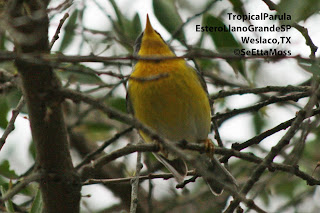
These warblers were pretty challenging to photograph as, in addition to the bright gray overcast sky, they are in almost constant motion and often engaged in chasing each other away from some juicy morsel. The mixed flock in which this Tropical Parula was foraging included at least 2 Orange-crowned Warblers, 1-2 Yellow-rumped Warblers, 2 or more Ruby-crowned Kinglets and the Black-throated Gray Warbler in the less than complete pic below (have to look close as pic not good enough quality to enlarge much). SeEtta

Tropical Parula, another nice Estero Llano Grande SP bird

Image
I was delighted to see and photograph this apparently overwintering Tropical Parula today. It has been reported for several days foraging in a mixed flock of warblers and Ruby-crowned Kinglets traveling in the former rv park area of Estero Llano Grande State Park in Weslaco, TX and that is where I photographed it. I believe this is a male Tropical Parula but I haven't seen that many so I hope someone will correct me if I am in error. A few more pics in next post. SeEtta

White-throated Thrush-another rare vagrant in TX

Image
This morning I photographed this White-throated Thrush, another rare visitor to the Rio Grande Valley of Texas. It flew in to a tree near a water feature in the former RV park section of Estero Llano Grande State Park. It slowly worked it's way down through the branches and landed in the shallow water where it drank for a minute or so until some Chachalacas flushed it with their fussing. It made it's way back into the top of the trees then flew off out of sight. Again the bird was in a dark area so my photo is pretty dark too. SeEtta

One So Texas Great Egret

Image
I took these pics of this very photogenic Great Egret right from the deck of the visitor center at Estero Llano Grande State Park in Weslaco, TX. It's amazing the great close-up views of birds and other wildlife at this very birdy location, one of the World Birding Centers in the Lower Rio Grande Valley. Double-click on these pics for super closer views. SeEtta

More LeConte's Sparrow pics

Image
Having found two LeConte's Sparrows in a week was made sweeter when this bird came out into the open and stayed put for at least 5 minutes while I snapped pics and slowly approached closer. I was very pleased to get the top pic that shows the bird's nape quite nicely. I got these pics from only about 25 feet away. At the CBC compilation we found out there were about 5 LeConte's Sparrows found on this count and all were in or around the Estero Llano Grande State Park.

CBC LeConte's Sparrow

Image
First I spotted a LeConte's Sparrow during the La Sal Vieja Christmas Bird Count on Dec 27 then this one on Jan 3 during the Weslaco CBC at Estero Llano Grande State Park--these are the first two LeConte's I have ever seen. Only a few of these have been found back in Colorado where their status is of very rare vagrant. So it was pretty cool to find two in less than a week. SeEtta