Posts

Showing posts with the label Red-napedSapsucker

Red-naped Sapsucker on a cold winter's day

Image
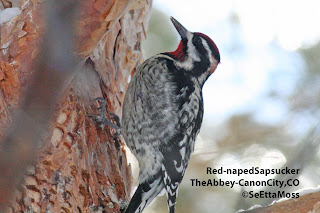
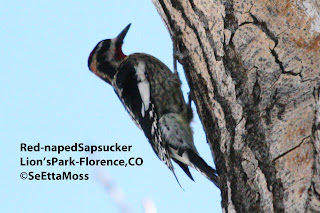
Today was a overcast and cold day with a lot of snow still on the ground from snowstorm the prior 2 days. This is my first of the season Red-naped Sapsucker which seems likely to be here for the winter season. In the top pic it is clear that the red throat feathers invade the black frame substantially-one of the distinguishing field marks for differentiating Red-naped from Yellow-bellied (which I also found today and will post later) Sapsuckers. The red throat identifies it as a male. While barely visible in top pic it's good sized patch of red on it's nape is clear in the bottom pic. Note the very dark back. SeEtta

Happy Holidays

Image
Happy Holidays to all. This Red-naped Sapsucker doesn't need a Santa Hat photoshopped on it's head, it has it's own. Took this photo in Canon City on Saturday. SeEtta

Red-naped Sapsucker: 2 more close-ups

Image
As below, the increased sunlight allowed me to get these two additional close-ups of the male Red-naped Sapsucker in the dry gulch/wash I have followed. I was happy to get some views of it's yellow belly though they don't show up as bright as they did since the sun was behind the bird. Visible are some of the sap wells in this siberian-type elm. I returned today to see if he was still there but I did not see him and expect he may have continued his migration travels. SeEtta

Red-naped Sapsucker: interesting views

Image
Yesterday the sun was shining better and though this Red-naped Sapsucker stayed in the shade, I was able to get this close-up that highlights his bright red throat and crown. And I got the pic below when he was stretching, providing a rarely seen view of the underside of his wings.  SeEtta

Sapsuckers migrating via dry washes in Colorado?

Image
In the fall of 2010 I found and followed several Williamson's Sapsuckers drilling sap wells in a complex of siberian-type elm trees south of Canon City that were in a dry gulch/wash located in pinyon juniper habitat. I noted some thoughts at that time that they these sapsuckers, that breed in conifer forests and especially aspen stands at higher elevation (7,000 feet+) in Colorado, might be using these dry gulches/washes for migration. Last year was a poor year for Williamson's Sapsuckers around Canon City but this year got off to an early start when I found 2 males and a female in Lakeside Cemetery on August 28, a good month before I have previously seen this species here. Since then I have found several more Williamson's in the area including the these in the top two pics here that were on the siberian-type elm tree (only 2 trunks as much of the complex was destroyed last year) in the dry gulch/wash where I found them 2 years ago. And yesterday I found the R...

Red-naped Sapsucker at the Abbey

Image
I spotted a Red-naped Sapsucker 4 days ago at the Abbey when it chased off a Williamson's that was feeding on one of their pine trees. I didn't get to see it well enough to tell it's gender but I photographed this Red-naped there today and it is a male. It was feeding on one of the diverse species of deciduous trees on the Abbey's grounds. Not sure if it is just stopping over to feed during migration or if it is an early 'wintering sapsucker' that stay in Canon City usually from Oct to late winter. SeEtta

Sapsuckers still wintering in Canon City are: focus on Red-naped

Image
After being careful in looking for those sapsuckers that are overwintering so as not to interfere with feeding or flush them (using valuable energy to escape) after the extremely harsh weather recently, I was less reticent to do a more complete survey as part of the Great Backyard Bird Count, since the weather has been much warmer for over a week (sap appears to be flowing again and not frozen). I refound this male Red-naped Sapsucker as well as the male that has been in Florence. The top pic gives a good view of how the red feathers on the throat of Red-naped Sapsuckers invade the black feathers that form an incomplete frame around the throat that distinguishes this species from Yellow-bellied Sapsuckers. SeEtta >

High of 5 degrees-cold Red-naped Sapsucker

Image
Yesterday was nice compared to today. After a low of minus 3 degrees in Canon City (worse in other front range cities), the high only rose to plus 5 degrees at midday. I went out to check on the wintering sapsuckers to see if they would be trying to drill holes in frozen trees and lap up sap that must be thick from well below freezing temps. I took care to stay far enough back from trees where I have found them so I wouldn't flush them--they need increased food intake in cold weather so I wouldn't want to disturb any feeding they are able to do in this bitter cold. I was surprised to find this male Red-naped and 2 female Williamson's Sapsuckers, including one I missed on yesterday, at least attempting to feed. When I saw this Red-naped, he was just perched as shown with feathers fluffed--it didn't make any attempts to drill or feed during the short time I was there but as shown in this pic there are a number of sap wells circling around this long-leafed pine tree....

Wintering sapsuckers: Red-naped

Image
All but one of the sapsuckers I have found overwintering this season in Canon City have been Williamson's except this male Red-naped that I refound where he was previously seen at The Abbey. Some birders might misidentify this male as a Yellow-bellied as the 'frame' around it's throat is relatively heavy for a Red-naped (and some Yellow-bellied have some red feathering on their napes); however, the black frame is broken, at the place where it bends, where some of the red feathers cover it and almost meet the white feathering. Also consistent with it's Red-naped identification is the reduced amount of white on it's back and the clear separation of the white feathering into 2 longitudinal bands (though I find this is not always a definitive field mark). SeEtta

Another Red-naped Sapsucker

Image
Today was the first time I have spotted this male Red-naped Sapsucker though it was found this fall in Lion's Park in Florence,CO. Though some of this species have definite red coloring of their nape, this one has just a wash of red in his nape area. I was unable to find the female Williamson's Sapsucker I found there several weeks ago. SeEtta

WinterSapsuckerFest in Canon City, CO--Red-napedSapsucker

Image
I found this male Red-naped Sapsucker yesterday, also on the grounds of the Abbey in Canon City,CO. Red-naped Sapsuckers have occasionally wintered in Canon City. They are also a species that is known to migrate south, even further south than Williamson's, to winter in south New Mexico and West Texas as well as Mexico. This male shows a clear though not extensive red nape. I added the bottom pic as it shows well the difference in back pattern between Red-naped and Yellow-bellied Sapsuckers with this species showing 2 rows of white feathers that are fairly well demarcated (while the white on the back of Yellow-bellied Sapsuckers is much more diffuse). SeEtta

Red-naped Sapsucker-wintering in Canon City,CO

Image
I found this Red-naped Sapsucker on December 12 and it continues to winter here in Canon City, CO. Though Yellow-bellied Sapsuckers winter here every year, Red-naped are not found every year. They generally winter from the middle of New Mexico and south into Mexico at this latitude. Though Yellow-bellied Sapsuckers have more generalized white on their backs, more limited white on Red-naped Sapsuckers occurs in two longitudinal patches as clearly shown in the top pic.This bird has a lot of red on it's nape as shown clearly in the second pic. Another difference between Red-naped and Yellow-bellied Sapsuckers is the framing around their throats--the red throat feathers of this male Red-naped invade the black malar stripe that makes up the frame while on a Yellow=bellied the frame is intact. I took these pics with my Canon dslr camera with a 400 mm lens (effective focal length of 640mm as camera is not full frame) then cropped pics to get these enlargements. Be sure to double-cl...

Red-napedSapsucker: video clips

These are two short video clips that show the Red-naped Sapsucker perched high on a deciduous tree engaging in grooming and some loafing. I video-scoped the sapsucker so it did not seem to be bothered by my distant presence, one of the main reasons I took up digi-scoping and video-scoping. SeEtta

More Red-naped pics

Image
The top pic shows off the head pattern found on male Red-naped Sapsuckers--this one has a good patch of red on it's nape, red crown showing a little, bright red throat (distinctive of males), black and white facial stripes, frame around throat incomplete. In included the middle pic as I rarely get such a good shot of the crown which is quite red on this bird. And though the bottom pic shows off the red feathers on the bird's nape, I included it because it shows off the back pattern with 2 well-defined rows of white feathers that are also field marks for distinguishing Red-naped from Yellow-bellied Sapsuckers. SeEtta

And the Abbey's Red-naped Sapsucker

Image
Now that I have posted pics of male Yellow-bellied Sapsucker at Centennial Park as well as the female Williamson's and Yellow-bellied Sapsucker at the Abbey, these are pics of the last sapsucker I found--a male Red-naped sharing the pine trees that are favored by all of these sapsucker species when they winter in Canon City. I really like pics in which I catch a glimpse of a bird's tongue like in the top pic here. I noted in the last post on the female Yellow-bellied Sapsucker that they have fully framed throats while Red-naped Sapsucker's do not. This bird has a better developed frame than most Red-naped that I have seen, but the top 3 pics show that the frame is incomplete where the section bordering the face meets the section bordering the breast. The second pic also shows well the bright red throat feathers on this male. I uploaded the bottom pic to show off the upper tail coverts and tail feathers that are not often shown in pics of sapsuckers. More pics in the ne...