Posts

Showing posts with the label AmericanKestrel

American Kestrel and Cedar Waxwings

Image
Caught this American Kestrel just as it was above to bite down on a grasshopper. This is one of a half dozen Cedar Waxwings I spotted yesterday feasting on juniper berries in Canon City.

Last climbing kestrel pic

Image
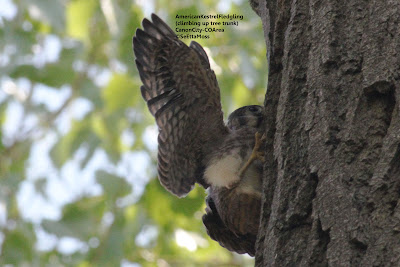
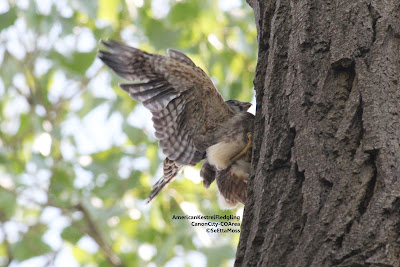
This photo provides a better view of the young Kestrel's claws clinging to the bark of the tree trunk it is climbing. It appeared to use it's tail for balance similar to how woodpeckers do. Since young Great Horned Owls that climb tree branches when they first leave the nest are called 'branchers', could these kestrel's be referred to as 'trunkers'?-lol. SeEtta

Am Kestrel fledgling, more pics on tree trunk

Image
The top pic shows the American Kestrel fledgling as it is hopping up the tree trunk while using flapping it's wings to assist it in climbing up the tree. This was most unusual to observe. SeEtta

Am Kestrel fledgling-climbing up a tree!

Image
I had previously observed a pair of American Kestrels that I thought were nesting in a cottonwood grove between the Arkansas River and a hay field on my friend's organic farm in the Canon City, CO area. Today I found this young fledgling clinging to the trunk of one of the large cottonwood trees in this grove. As it climbed the tree, hopping up with the help of it's wings, both apparent parents flew around and called often. More pics to follow. SeEtta

American Kestrel: chowing down

Image
It didn't take this female bird long to start eating her grasshopper prey, a frequent meal item for this species. It's interesting how she holds her prey in one 'hand' while she eats it. SeEtta

American Kestrel: only a few yards above

Image
Here is another a in series of close-up encounters I have experienced in the past few weeks--this time this American Kestrel flew onto a tree branch less than 25 feet above me earlier this week. This is especially surprising as I have found this species to be pretty wary of people. If you super-enlarge this pic (by double clicking on it then clicking on it again) you can see that the prize it is clutching in it's foot is a grasshopper. With her mouth open, she seems to be ready to devour her catch. More to come. SeEtta

Kestral and Redheads

Image
This male American Kestral was hunting near my motel in a commercial area of Westminster, a suburb northwest of Denver. These Redhead ducks were in a small farm pond in which more than 90 Redheads were gathered. SeEtta

The smallest falcon: American Kestral

Image
I think most of us enjoy seeing these colorful female American Kestrals, the smallest member of the falcon family. This little lady was hunting in a field in my town of Canon City,CO when I took these pics today. I think this species has such a sweet looking face that conceals the reality that are hunters of live food. Their prey includs warm blooded critters such as backyard birds (which can be upsetting to those who feed the birds they take), but it also includes mice (which many of us applaud). Many who display the photos they have taken of birds include only those with clear head shots and rarely show back views or views of the underparts. Since in the real world we often see birds from behind or underneath I think it is important to post pics showing what that looks like. SeEtta

Residents: Am. Kestrel & Brown Creeper

Image
Unlike the Cedar Waxwings which come and go during the irruptions, and the migrating Hermit Thrush, both American Kestrels and Brown Creepers are year-round resident species in the Canon City area as well as much of Colorado. I photographed this Am Kestrel on the grounds of the Canon City Abbey, apparently a favorite hunting area for this bird as I have seen it there a number of times in the past few week. The Brown Creeper was foraging actively at the Canon City Riverwalk in the company of a second creeper, an association that I often see with this species in the fall. SeEtta