Posts

Showing posts with the label HolcimWetlands-Colorado

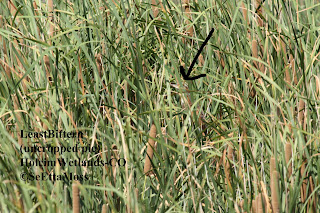
Least Bittern fledgling taken yesterday: pic not cropped
Image
As I have had questions about whether the Least Bitterns I saw yesterday were in the middle, top or bottom of the cattails, I am posting this pic that I did not crop so you see what the bird looked like through my long telephoto lens combo (400mm lens + 1.4 extender and with a 1.6 multiplier for not having a full frame camera=equivalent of around 900 mm telephoto or 18 X's normal lens). This also shows the challenge these birds presented for photographing especially since I have to focus manually. Click on pic to enlarge then click on it again to get better view. SeEtta

Least Bitterns: the male

Image
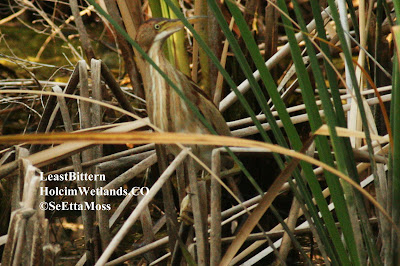
Shortly after I watched a fledgling (or two) practice clinging to a cattail and looking around (possibly to see what caused all the noise and vibration--a local rock quarry train had pulled up and stopped on tracks about a hundred feet from the birds), I spotted this Least Bittern which I believe due to it's darker plumage is the male. The bottom pic really shows off the coloration from it's crown down to it's flight feathers. These pics really show details if you click on them to enlarge then click again to super enlarge. SeEtta

Least Bitterns near Canon City, CO: fledglings!

Image
Due to post surgery restrictions I haven't been able to get out to the Holcim Wetlands where the Least Bittern was found 2 weeks ago. Since then other birders have seen possible male and female birds raising the possibility that there might be breeding occurring. I went out this morning and looked for them from 7 am to 11 am--I could hear Least Bittern soft 'cooing' calls off and on but could not spot any birds. Interestingly, the location the calls were coming from was right where I had photographed the Least Bittern the first time as it hunted. When I left I stopped for some food in nearby Florence and checked my email on my Droid phone--a post this morning while I was at Holcim stating he had seen a male, a female and 2-3 fledglings yesterday between noon and 1pm. So I gobbled down my food and returned to Holcim Wetlands to try again, at this unusual mid-day time frame. Doug had made it sound like a piece of cake but it wasn't so for me. I had even sat on th...

Least Bittern: hunting at Holcim Wetlands-CO

Image
I returned 4 days ago to Holcim Wetlands before 7 am to try to refind the rare Least Bittern and hopefully get some pics in good light. Though I succeeded, the bittern was much more distant than when I photographed it last week in the evening (at least a hundred feet out). However, I was able to get postable pics of it engaged in classic bittern hunting as is shown in the two pics. Note that it is 'perched' by straddling cattail shoots, a feet made possible by their small size, allowing it to strike downward at prey in the water below. Gee-these pics are almost identical though the sun was out in the bottom pic but not in the top pic (the top pic was taken at F10 while the bottom pic at F8 as a result). Actually these show a progression, a very, very slow progression of the hunt--look closely and you will see that the bird's bill in the 2ndh pic is a few inches forward of and below the position in the 1st pic. So what? The 2nd pic was taken 3 minutes after the 1st pic...

Rock Wren at wetlands??

Image
As I sat quietly waiting for the Least Bittern at Holcim Wetlands this rather disheveled Rock Wren 'appeared' by a log less than 10 feet away. It seemed curious about me and kept hopping out from the safety of the log coming within only about 5 feet. My little dog was lying beside me but the bird seemed indifferent to him,maybe because he was lying still also. From the looks of this wren it is molting. After hopping around for several minutes it flew off away from the wetlands and towards the RR tracks--the only location nearby with rocks is around the RR tracks. Maybe the wren had gone down to the wetlands for a bath. I cropped the top pic in order to produce the super close-up in the bottom pic (very fine details can be seen by clicking on the bottom pic then clicking on it again). SeEtta

Least Bittern: the last pics

Image
The sun was out from behind some clouds providing better lighting for these pics. I really like this top pic as it shows the neck plumage well and I think this is very cool looking. I also like the bottom pic for showing off the interesting wing plumage with the buff colored wing patches surrounded with chestnut and then white feathers. Shortly after I took this pic the bittern retreated back into the thick cattails. SeEtta

Oops, Least Bittern is looking at me

Image
In the top pic the Least Bittern is looking directly in my direction and I suspect it has heard the mechanical clicks of my Canon dslr camera (yes, the bells are all turned off but all cameras make some amount of mechanical noise when the shutter is depressed and I have found other birds disturbed by it). I stayed very still and quiet so the bittern did not flush but instead stayed for another couple of minutes. The bottom pic, next in the sequence, shoes it went back to it's hunting position with beak jutted out in front with head and body pretty parallel to the ground. SeEtta

Rare Least Bittern at Holcim Wetlands in Colorado

Image
This Least Bittern was found this week by a local birder, Rich, at the Holcim Wetlands east of Florence,CO. This is a rare bird in any part of Colorado and the first seen in this county. I took the top pic as the bird poked it's head out from behind the cattails. In the bottom pic the bird had stepped all the way out and had assumed the hunting position. More pics in next posts. SeEtta

Black-crowned Night-Heron: immature bird

Image
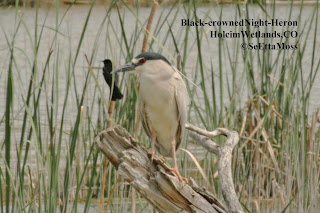
This immature Black-crowned Night-Heron is also in Holcim Wetlands. I think it is likely a first spring bird though it's plumage is similar to juvenal plumage. It flies quite well (not like young fledgling), it was out foraging on it's own, and according to Colorado Breeding Bird Atlas I the earliest fledged young recorded in Colorado was on June 21-and it takes young fledglings awhile to become as independent and skilled in flight as this bird. Additionally this birds' iris appear pretty orange which Birds of North America (BNA) online indicates would be consistent with first spring bird--"bright yellow by 20–30 d, orange-chrome by 1 yr, and bright red by 2–3 yr of age". Also it's upper mandible looks "black with greenish olive sides basally" which BNA states is found at age 1.

Black-crowned Night-Heron: adult in flight

Image
I was really happy to get this pic as one of the adult Black-crowned Night-Herons flew from the Holcim Wetlands to nearby riparian forest to roost.

Black-crowned Night-Heron: adult in flight

Image
I caught these two pics of one of the adult Black-crowned Night-Herons yesterday. I thought the top pic gave an interesting view of it in mid-wing flap while the bottom pic showed the back of the bird nicely. SeEtta

Black-crowned Night-Heron: adult foraging during day

Image
I found this adult Black-crowned Night-Heron at Holcim Wetlands just east of Florence, CO this week. Though I have seen this species in Holcim Wetlands in previous years, there was no indication of breeding nor has there been any indication of their breeding anywhere in Fremont County where this wetlands is located. Today I found a second adult and both were foraging in the daytime, a behavior associated with nesting behavior per Birds of North America online. I also saw at least one immature Black-crowned Night-Heron and will post more about that above. SeEtta