Posts

Showing posts with the label HolcimWetlands-CO

Tundra Swans still here

Image
I have traveled to Holcim Wetland the past 3 days to monitor the Tundra Swans. I got this better flight photo on Thursday but not the way I would prefer. When I drove into the parking lot above the wetlands I could see the swans were still there and in the northwest section of the pond--they had their heads under the water feeding on "Aquatic plants, seeds, tubers, grains, some mollusks and arthropods." (from Birds of North America online). I had walked down the south trail to the west end as the swans were on the northwest part of the pond. As I walked west they began swimming east so I ended up at the west side with them on the east side of the pond--and clearly a move made to avoid me. So I waited about 10 minutes to see if they would see I was not going to bother them and return, but they did not. So I walked back on the trail with only minimal views of them as they stayed closer to the thick cattails which hid much of their bodies. When I got closer (almost direc...

Visit from two Tundra Swans

Image
We rarely get swans of any type in the Canon City area, the last were a few years ago. So it was nice to hear that a local birder had found two at the Holcim Wetlands just east of Florence. I was out of town all day so stopped by in the afternoon as I drove back. I was pleased to spot the two of swans flying back in to the wetlands after looking as much as possible with most of the trail still not repaired and off limits. I guess they might have been off somewhere feeding and were now  returning for the night. Thought I was photographing swans landing so was surprised to find this Canada Goose had photo-bombed on of the pics. This swan landing shows that swans are not always the graceful looking birds they are said to be. The swan below shows only a small amount of yellow in it's lores while the other swan shows a lot of yellow as is found on Tundra Swans. SeEtta When the two were right beside each other they look like exactly alike but the amount of ye...

TRICOLORED HERON at Holcim Wetlands-photo taken from side of CR120

Image
Wouldn't you know--the Holcim Wetlands had to be closed indefinitely after the very high water in the Arkansas River took out about 30 feet of bank including the trail, part of a small bridge that used to be over the tailwater stream. Now the wetlands are directly connected to the Arkansas River until Holcim can get engineering done and permission from the Corps of Engineers to repair it. So I was checking on it last evening from the side of CR120 that runs adjacent to the parking lot (it is closed off and locked. There was good water in the wetlands pond with several visible cormorants and a few Great Blue Herons loafing and feeding there. Then I spotted this TRICOLORED HERON, a big rarity in Colorado and a species that has been present in this wetland area during several previous summers including this one last year . At the several hundred foot distance my photo does show the white belly and long neck with some view of the white foreneck found on this species. You can cl...

Flooded Colorado birding hotspot-Holcim Wetlands

Image
After some unprecedented amounts of rain at my house in Canon City (approx 5 inches in 36 hours) I drove out to Holcim Wetlands to see how it was fairing. It was clear from the road, as shown it top photo, that the trail entrance that goes under the RR bridge was flooded as was Hardscrabble Creek that caused the trail to be underwater. I ran into a Holcim employee in the parking lot and accompanied him via an alternate route to check on damage to the wetland and trail area from flooding. The photo just above shows a more close-up view of the very flooded Hardscrabble Creek and now under a foot of water trail entrance. It will be awhile before the water is gone and the mud that will remain dries to allow entry. The third photo shows the wetland pond area that is almost to bankful due to flooding. We found that the Arkansas River, which runs adjacent to the wetlands, had flooded through the trail in several locations on both the west and north sides causing extensive da...

Green Heron

Image
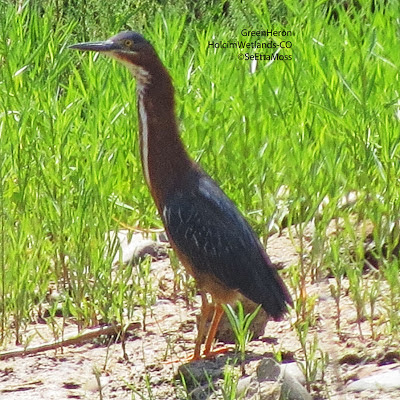
Yesterday while 'touring' local birding hotspot-Holcim Wetlands-with Holcim staff I saw 3 Green Heron including this one. Only a few other birds--Great Blue Heron, small flock of Blue-winged Teal, a couple of DC Cormorants--partially due to the flooded wetland area. More on flooding above. SeEtta

Green Heron at Holcim Wetlands

Image
Though I frequently see one or occasionally two Green Herons at the Holcim Wetlands they are usually distant or flying quickly away so I don't get reasonable photos. This one flew out of the reeds to this open area for a few minutes. SeEtta

TRICOLORED HERON continues at Holcim Wetlands

Image
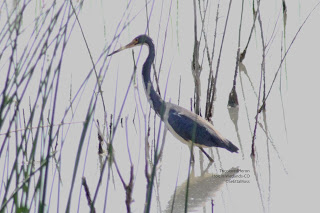
I got these pics this morning. The TRICOLORED HERON has continued to be seen daily at Holcim Wetlands. I usually see it actively foraging as shown in the bottom pic. SeEtta

Tricolored Heron is back east of Canon City, CO

Image
This Tricolored Heron was seen yesterday at Holcim Wetlands after an absence of about a week. Interestingly a Tricolored Heron was seen 8 days ago about 125 east at Lake Hasty after the one I found at Holcim had not been seen for 5 days (last seen 6-17, one found at Lake Hasty on 6-22). Since Tricolored Herons are very rare in Colorado it seems most likely that the bird I photographed at Holcim today is the same one I found there on 6-14-13. The question is this the same bird that was at Lake Hasty--did it fly down there and return to Holcim??? SeEtta

LEAST BITTERN at Holcim Wetlands

Image
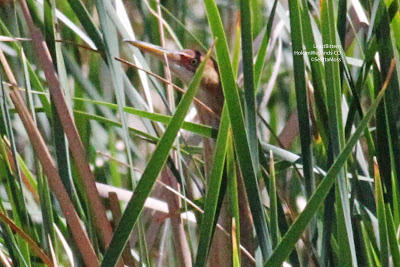
Though I saw the LEAST BITTERN (actually saw 2 together) today I did not get any new photos. I took this yesterday and I believe it shows field marks for a male LEAST BITTERN: the neck and sides are chestnut brown or what Cornell's All About Birds website calls 'warm orange-brown' in my opinion. I don't have a view of the back but the neck and sides are a lot darker than the 'pale yellow buff' (per Sibley's). I did not get a diagnostic view of the 2 LEAST BITTERNS today so I can't say if either looked to be a male or female; but it would seem likely, given that this species has nested here before, that there was a male and female. SeEtta

TRICOLORED HERON continues at Holcim Wetlands

Image
The TRICOLORED HERON I found 2 days ago at Holcim Wetlands east of Florence,CO continues at that location. It has been staying further from view near a section that is closed for nesting season since the evening of the first day I found it. I suspect it has felt disturbed and has found this location more to it's liking since now that the big push of fishing is over there are fewer who trespass the closed trail that is signed as closed. It does not provide the great views I and several more birders got that first day but it can be viewed and field marks are evident. SeEtta

LEAST BITTERN present again at Holcim Wetlands in south central Colorado

Image
I photographed this LEAST BITTERN this morning at Holcim Wetlands which is about 25 miles east of where I live in So Central Colorado. I thought I spotted one diving down into the large area of cattails in the center of these wetlands. This morning a Least Bittern was found 3 times as it flew and kind of hopped low in the cattails. These are all the same photo but the the middle one is cropped and the top is very tightly cropped to show the head and neck of this small bittern better. The bottom pic is uncropped--but is the view produced from my Canon dslr 60d camera with a 400 mm lens and a 1.4 extender--with the 1.6 multiplier due to camera not being a full frame this combo provides approx 900 mm view or 18X enlargement. SeEtta Post note: if you can't see the LEAST BITTERN in this bottom photo just click on it to enlarge then follow the arrow (that isn't as obvious as I thought it would be)

TRICOLORED HERON, a rarity here in Colorado

Image
This morning I found this adult TRICOLORED HERON at Holcim Wetlands about 25 miles east of Canon City. This species is a rarity here in Colorado. It was foraging actively in the shallow water. I also found a Green Heron and 3 Black-crowned Night-Herons this morning at this very productive wetlands that were created from an abandoned gravel pit that was likely in one of the old channels of the nearby Arkansas River. SeEtta

Bohemian Waxwings fly-catching aerial insects

Image
Today I drove to the Holcim Wetlands east of Florence,CO to check on Great Blue Heron nesting. Didn't see any evidence they were refurbishing last years nests or building new ones but spotted some unusual looking 'fly-catchers.' Turned out to be a small flock of about a dozen Bohemian Waxwings sallying out from a dead tree adjacent to the Arkansas River. This irruptive species has been reported about 15 miles north of here in El Paso County in the past several weeks. I had not heard of this before but I have very limited experience with the species. I checked Birds of North America (BNA)online and found the following: "Noted for sallying from exposed perches, often near water, to feed on aerial insect." Exactly what I had observed. Interestingly there were a lot of Russian Olive trees loaded with their fruit that about 50 robins were feasting on. Though BNA noted that Bohemian Waxwings do eat Russian Olive fruit in the winter these birds stayed hi...

Likely hybrid Eastern X Black Phoebe

Image
I also found this bird, a very blackish phoebe, at the Holcim Wetlands. It had mostly black feathers on head, back and wings with white throat, yellowish underparts and smudie sides. Holcim Wetlands is in Fremont County, Colo where I have followed a number of nestings of mixed Black and Eastern Phoebes. SeEtta

Late nesting Ash-throated Flycatcher

Image
I spotted this Ash-throated Flycatcher carrying this grasshopper, presumably to feed young, at Holcim Wetlands. Since I followed it to a tree about a hundred feet from where I first saw it (and several minutes later while I hiked around to where it landed) and it still had the food in it's bill. This is a late nesting for this species. The first Colo Breeding Bird Atlas shows them feeding young from May 27 to July 24, a full three weeks earlier than this bird. SeEtta