Posts

Showing posts with the label EasternFremontCo-Colo

One more Goshawk pic showing supercilium

Image
I think this pic shows the white supercilium that is one of the field marks of this species. SeEtta

Northern Goshawk in flight

Image
Soon the juvenile Northern Goshawk was flushed by the bird mobbing it and I caught these pics as it flew past me. Northern Goshawks are noted to use "all types of coniferous forests" during winter according to Colorado Birds by Andrews and Righter. Though the photos lose quality, the eyes can seen by double clicking on the top pic to enlarge eye. SeEtta

Northern Goshawk, a cool find

Image
As I walked back down the dry gulch where I was looking for sapsucker work, I spotted this juvenile Northern Goshawk perched in a deciduous tree on the top of a ridge several hundred yards away. As I took these pics I saw that a bird was harassing the goshawk. More in next post. SeEtta

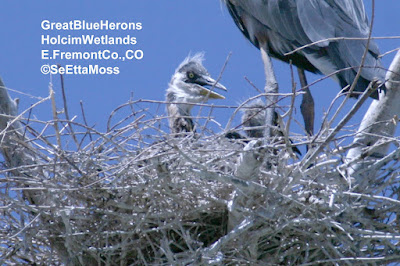
Another pic of Great Bluer Heron nestling

Image
For a super close up view, double-click on the pic to enlarge it. I took these pics with my digital SLR camera with a 400 mm lens and a 1.4 extender--combining that with the multiplier of 1.6 because it is not a full frame camera, I am shooting the equivalent of close to 900 mm. It is unethical to approach nesting herons or other birds too closely--they do flush from their nests when humans are close (which I observed this week when the owner of some cattle that had strayed into the area walked right underneath the nests) which puts eggs and very young nestlings in danger from the elements. Also Great Blue Herons as well as other birds do abandon their nests and nestlings due to too much disturbance. If you want good photos of these birds it is your obligation to get the photo equipment that does not put the birds at risk.

Great Blue Heron nestlings

Image
For super close up views, double-click on the pics to enlarge them. These Great Blue Herons are in rookery that nests in large cottonwood trees in Holcim Wetlands in eastern Fremont Co., CO. This year a group of Double-crested Cormorants began nesting there also. The nestlings in these pics are young. They won't begin to fly until they are 50-60 days of age but at least one was already learning to extend it's wings and make a few flapping motions while I was there. SeEtta