Posts

Showing posts with the label CanonCity-COAreaFarm

More Black Phoebes in Canon City and surrounding areas
Image
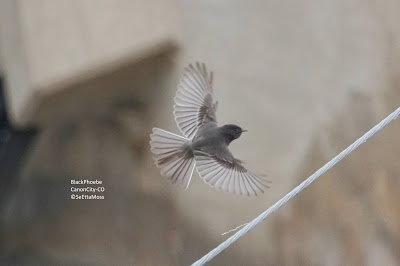
The top pic is one of a pair of Black Phoebes that I have for the past week or so on a friend's property just east of Canon City. These other two pics are of a single Black Phoebe I spotted at Florence River Park. SeEtta
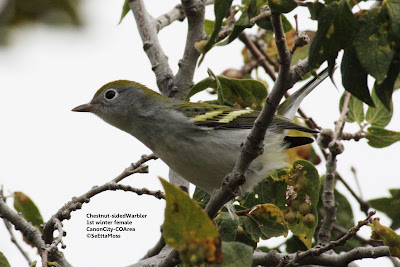
Best photo of this Chestnut-sided Warbler

Image
I think this photo shows all the field marks for a female Chestnut-sided Warbler in 1st winter plumage. I would gladly take a dozen more of her. SeEtta

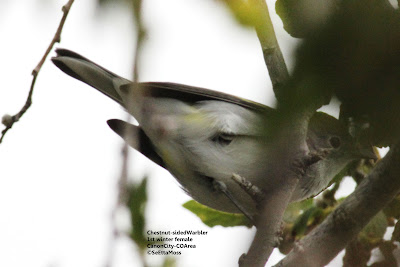
Chestnut-sided Warbler-photos of underparts

Image
When I typed 'photos of underparts' I thought that this almost sounds naughty. However, underparts of birds are important in establishing species, gender and age. In this bird, the green upperparts, plain white underparts, yellowish wing bars and white eye ring with the lack of any chestnut is diagnostic for 1st winter female Chestnut-sided Warblers. SeEtta

First winter female Chestnut-sided Warbler

Image
Birding this morning was fairly slow only a few warblers (Wilson's, Yellow)that haven't moved on. Then I found this beautiful Chestnut-sided Warbler, a female in first winter plumage. What gorgeous green color on her head and back! I really liked the bottom pic as the color came through so well, even with overcast skies that tend to suck color from photos, that I did no tweaking-just cropped to enlarge. More pics to come. SeEtta

Last climbing kestrel pic

Image
This photo provides a better view of the young Kestrel's claws clinging to the bark of the tree trunk it is climbing. It appeared to use it's tail for balance similar to how woodpeckers do. Since young Great Horned Owls that climb tree branches when they first leave the nest are called 'branchers', could these kestrel's be referred to as 'trunkers'?-lol. SeEtta

Am Kestrel fledgling, more pics on tree trunk

Image
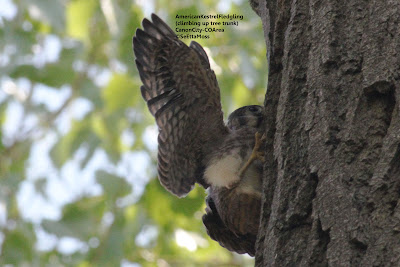
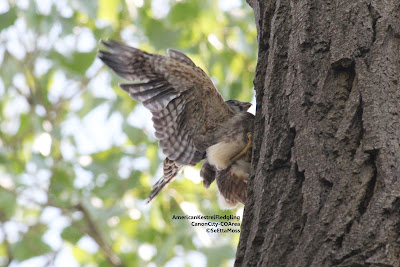
The top pic shows the American Kestrel fledgling as it is hopping up the tree trunk while using flapping it's wings to assist it in climbing up the tree. This was most unusual to observe. SeEtta

Am Kestrel fledgling-climbing up a tree!

Image
I had previously observed a pair of American Kestrels that I thought were nesting in a cottonwood grove between the Arkansas River and a hay field on my friend's organic farm in the Canon City, CO area. Today I found this young fledgling clinging to the trunk of one of the large cottonwood trees in this grove. As it climbed the tree, hopping up with the help of it's wings, both apparent parents flew around and called often. More pics to follow. SeEtta

Eastern Bluebirds: dad doing the feeding

Image
The male Eastern Bluebird was a faithful parent that brought food about as often as the female while I was watching. As the nestlings grew older they would come up to the nest hole and open their beaks wide for feeding. SeEtta

Eastern Bluebird nestlings

Image
The Eastern Bluebird nestlings became very impatient about waiting to be fed and would stick their heads out the nest hole looking for their parents. It wasn’t long before I would hear the parents calling to the nestlings to encourage them to ‘fledge‘ from the safety of their nest hole into the scary world outside. The video clip below shows one of the nestlings that is very near to leaving the nest–it is calling back to the calls of a parent bird as it climbs onto the edge of the nest hole. The male flies in and provides a quick meal though the nestling quickly starts calling again for more food. SeEtta

Eastern Bluebird nest cavity

Image
The nest cavity being used by this pair of Eastern Bluebirds is in the dead tree limb marked by an arrow in the photo on the right. It is on a river bank between a hay field where the I have watched the parent's hunt for food many times and the river which also provides good insect habitat.  SeEtta

Eastern Bluebirds: video of pair

Image
The video above shows first the male then the female Eastern Bluebirds fly to the nest cavity to feed their nestlings then 'fecal sacs' to keep the nest clean. I thought the color of the bird's feathers was brilliant in the video clip when the sunlight hit them. Above photo shows the male with it's head inside the cavity--he continues to be very task oriented: he flies in and quickly delivers the food to the nestlings and take the fecal sac, rarely bothering to look in my direction. The female shows less concern about my presence but still looks over at me, and at surrounding area, several times while at the nest.  I take my photos from inside my car and my videos using a tripod right next to the car door so I can use my car as a 'blind' , a technique I use frequently as it disturbs birds less and provides better photos and videos. I stay more than 30 feet away then use a very long telephoto set-up (close to 900 mm equivalent) to get these close-ups....

Lewis'sWoodpecker: nice tail views

Image
Just two last pics of this Lewis's Woodpecker bringing food to nestlings that give nice views of the tail. Woodpeckers have very stiff tail feathers that they use to help anchor them to provide stability when engaged in drilling. "The bending stiffness of woodpecker tail feathers is especially high. . . It is this feature that makes them good for bracing the woodpecker against the forces of pecking." (page 9) SeEtta

Lewis'sWoodpecker: is this food white bread?

Image
A former entomologist with the Colorado State Forest Service emailed me that this food item is not an insect or larvae. He said he thinks it is bread. Since the nest is about a quarter mile from two homes plus farm workers in nearby fields may drop white bread, it would certainly be feasible for this Lewis's Woodpecker to opportunistically appropriate some bread thinking it would be easy-food for the nestlings (though likely not a source of much nutrition for them). In the pics showing this food, it certainly has a strange consistency. For much closer views of this food just click on each pic then click on them again. SeEtta

Lewis'sWoodpecker: nestling sneaking a peak

Image
In the top pic the nestling has reached it's bill up to receive food (white stuff) from the parent Lewis's Woodpecker (it's bill is just to the right of the arrow). The bottom pic shows a nestling sneaking a peak between visits by the parent to the nest hole with food. This is first time I have ever seen a nestling Lewis's Woodpecker so I was very excited when I saw this pic in my camera's lcd viewer. The nestling has a hint of the strawberry coloration on it's lower face plus the gray/silver coloration on the neck area that is so distinctive of adult birds. The hatchlings fledged had fledged when I returned 2 days later. SeEtt

Lewis'sWoodpecker: feeding nestlings

Image
The Lewis's Woodpecker is in the process of feeding nestlings inside the nest hole in both of these pics. In the bottom pic it had turned it's back to me so this is a tail-end view of the bird as it inserted it's head into the nest hole. SeEtta

Lewis'sWoodpecker: bringing food to nestlings

Image
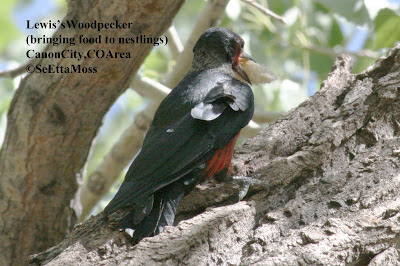
This is a parent Lewis's Woodpecker at the nest hole I found recently. In the top and middle pics this bird has some very good size white-colored food it has brought to the nest tree. I believe it is some kind of insect, or extra large larvae, as I could discern what looked like a couple of legs sticking out from it--I would love to find out if anyone could identify it. (this can be viewed close-up by clicking on each pic then clicking again on enlarge pic) After it flew to the next to the nest hole with the large food item, this woodpecker deposited it in crevice in the tree bark then proceeded to pound on it with it's bill. The bottom pic is when the bird rested during this process and it shows some of the food attached to it's bill--I suppose it was killing it then maybe breaking it into smaller pieces as it proceeded to take small pieces to the nestlings. More to come. SeEtta

More super close up pics of Green Heron

Image
I was able to get these super close-ups by using my car as a blind. The heron was less than 20 feet away but undisturbed as I was very quiet and moved slowly and stayed in my car. I took the pics with my Canon Xti with a 400mm lens,a 1.4 extender--as the camera is not full framed there is another 1.6 multiplier that nets about a 1000 mm equivalent--plus I cropped the photo but only a little. I really like the deep chestnut color on the plumage of this young heron. SeEtta

Super close-up of Green Heron

Image
Yesterday I was delighted to find this Green Heron on a farm pond at my friend's near Canon City,CO. I have seen adult Green Herons at this location every summer for the past 5 or so years and can't believe they would keep coming around this area unless they are breeding near here. This is the first evidence of local breeding since I saw a Green Heron carrying nesting material in the middle section of the Canon city Riverwalk which is about 2.5 miles away. This heron is in juvenal plumage but still has a few pin feathers which would indicate it is pretty young. More pics to come. SeEtta

Easten Phoebe bonanza

Image
After finding the Eastern Phoebe at Pathfinder Park this morning, I thought it might have been one of the two Eastern Phoebes I had seen last evening at my friend's property which is in the area. Whether it was or not, I was surprised to find a total of 3 Eastern Phoebes along with the juvenile Black Phoebe that has been staying by their pond for several weeks. The lighting wasn't good as it was late in the day and cloudy so I didn't see any yellow wash on their underparts, but I suspect 1-2 of these are juveniles. The bird in the top pic shows juvenile characteristics in the cinnamon buff edging shown on coverts. I don't think these were born on my friend's property but are moving through as they engage in post-breeding dispersal. They could even be from the first brood of Eastern Phoebes born at the old sewer tanks on the western part of the Canon City Riverwalk, about 4-5 miles west of this location. SeEtta