Posts

Showing posts with the label Florence-CO

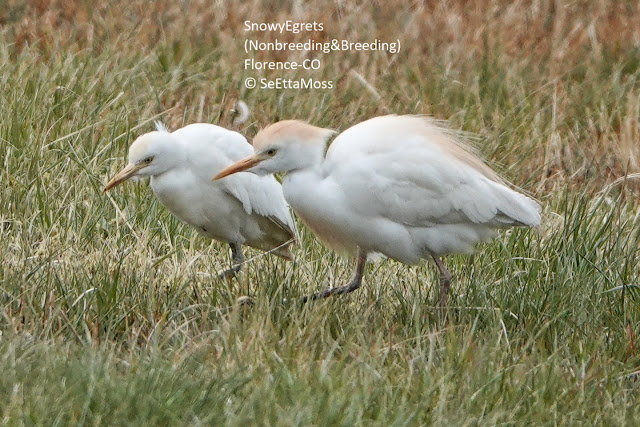
Cattle Egrets, both breeding and nonbreeding plumage
Image
I found these Cattle Egrets, one in nonbreeding plumage and the other progressed into breeding plumage, feeding together in a flooded agricultural field in the south central town of Florence. They have provided an opportunity to view these two plumage stages side by side. {Click on Read More to read the rest of the description and see more pics} The bird in both the pic above and below is the Cattle Egret in nonbreeding plumage. Note the very small amount of buff colored feathers and it's blackish legs (best seen in pic below), characteristics found on nonbreeding birds. The light buff on it's crown may indicate it has begun transitioning into breeding plumage. The bird in the pic above has transitioned to a large extent into breeding plumage showing a lot of buff colored feathers on it's breast (shows in top pic) back and head. However it's legs are still fairly dark so still transitioning yellow or pink legs seen on this species during breeding season. SeE...

American Pipits have arrived

Image
I had been looking for American Pipits all week as is around the time they have stopped over on their migration to feed and rest--and yesterday I found about a dozen of them foraging in an agricultural field in Florence. While most of the pipits had streaked chests, some were the 'light' adults as shown in the bottom two pics. All four pics here are of excellent quality so they can be enlarged to view really close up and for best viewing. SeEtta

White-faced Ibis, yearly spring migrants, have arrived

Image
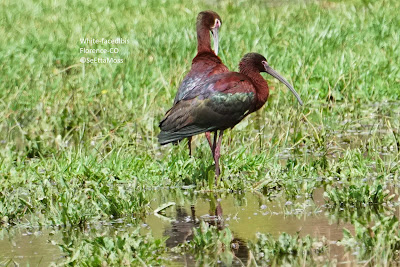
  Every spring flocks of White-faced Ibis stop-over in eastern Fremont County to feed and rest before continuing to their nesting areas. They feed in the flooded agricultural fields in both Florence and Canon City.    The First Colorado Breeding Bird Atlas showed that they used to nest in far eastern Fremont County likely where the current Holcim Wetlands (which were rebuilt after use as a rock quarry) are located. SeEtta

Video: Trumpeter Swan grooming

Trumpeter Swan in Colorado from SeEtta Moss on Vimeo . This short video shows the Trumpeter Swan in Florence, CO grooming. It was interesting that it dipped it's bill in the water then to it's breast to wash it's feathers. A couple of times Mallard Ducks photo bombed the video. SeEtta

Yellowlegs and Cinnamon Teal are migrating into Colorado

Image
Brightly colored male Cinnamon Teal are all around the area now even flooded agricultural fields like this one in Florence, CO where I found this guy. These Greater Yellowlegs were the first I have seen this year and are all decked out in their spring plumage. Also saw one Lesser Yellowlegs but didn't get a pic. SeEtta

Black Phoebe

Image
While Black Phoebes have overwintered a number of times in the Canon City area this is the first Black Phoebe I have seen for awhile. SeEtta

American Pipits still in Colorado

Image
This is one of two American Pipits I found at the Fremont Sanitation District Plant in Florence, CO today. They winter just south of Colorado in New Mexico and some are seen intermittently in Colorado. Still unusual to see them in winter here as I am used to seeing them in large flocks in South Texas in winter. SeEtta

Singing Bobolinks video clip and photo of female Bobolink

Image
A few days ago as I birded in Florence, CO, a little town near Canon City, I was surprised to find 5 male and at least 1 female Bobolink. Though I have seen Bobolink in this hay field previously it has been a number of years. And I was delighted to photograph this female Bobolink as they are not always easy to find. The best though was the very brief video clip of the two male Bobolink singing their bubbly song. SeEtta Bobolinks singing from SeEtta Moss on Vimeo .

Migrating shorebirds, waterbirds, ducks and even gulls benefit from flood irrigation of ag fields in Colorado

Image
As I live in a semi-arid part of Colorado, and we have few ponds/lakes, most migrating shorebirds and waterbirds that make it over this way utilize the flooded agricultural fields in Florence and Canon City areas. As this flood irrigation is not very efficient, and many of the agricultural fields on the edges of these two towns get supplanted by housing, flooded fields like these are in decline, though still slow due to a very sluggish economy and little building in this area. So what do these birds find to eat in flooded fields: Mostly various types of insects, small aquatic and terrestrial invertebrates, small fish, frogs, vegetation and seeds (depending on species of bird). I have certainly watched White-faced Ibis pull either large worms or small snakes out also. SeEtta

Glossy Ibis, rarish visitor to Colorado

Image
Today I found a small flock of about 25 White-faced Ibis, first of the year birds here, in a flooded agricultural field in Florence. I always check each dark ibis to look for the rarish Glossy Ibis, more likely found in eastern U.S., which I usually find in large flocks of around a hundred or so. Surprise, I found not just first of the year White-faced but Glossy Ibis. These photos show the bluish bare skin on it's face which are arranged as lines above and below the eye, and not going around the eye as with the bare skin on White-faced Ibis. Though the third photo just above is not as sharp, it is good for showing the difference in facial features of Glossy and White-faced Ibis right next to each other. The forth photo also shows the difference in these species though in a different perspective as they are loafing with heads resting on backs. The bottom pic shows the flock feeding in the flooded agricultural field. SeEtta

Black Phoebe casting a pellet

Image
I found this Black Phoebe last week on the property of the Fremont County Sewer District near their sewer plant where I have seen Black Phoebes for several years. As I watched the bird tossed it's head downward and I caught it in the act of casting a pellet, something more often associated with owls. However Black Phoebes and other birds that eat insects or other live prey whole do this to get rid of the digestible parts. Though a real sharp photo below, it does show the pellet and it's size relative to the bird. Casting of pellets by Black Phoebes is noted in Birds of North America (p. 6). I have only seen a Black Phoebe cast a pellet on one previous occasion. I have previously blogged a sequence of photos of a Scissor-tailed Flycatcher (and sharper than this one) as it cast a pellet. SeEtta

Cattle Egrets decked out in breeding plumage

Image
I found these 2 Cattle Egrets, and possibly a third, in a flooded field in Florence, CO today. They are fairly uncommon in this area and I always enjoy seeing them in their breeding plumage. SeEtta

Glossy Ibis

Image
I finally found a flock of over a hundred dark ibis in a flooded field in Florence on Thursday and in it was a bird that looked pretty good for a Glossy Ibis with powder blue lines that appeared to frame it's eyes. And it's eyes looked dark-- at first. However, the eyes when viewed more close up after enlarging the photos has some reddish hues and I see that some of the blue edging does continue around behind the eye which are indications of a hybrid Glossy X White-faced Ibis. I have had feedback from two skilled birders whose opinions I respect, both stating that they believe this bird to be a Glossy Ibis. One noted that the reddish caste of the eyes may be a photo artifact. That was also thought to be the reason the blue edging looked to go a short ways around the eye. I think they made good points and I have changed the id to Glossy Ibis. SeEtta

Yellow-headed Blackbirds, squabbling boys

Image
I have been seeing up to several dozen Yellow-headed Blackbirds in Florence for the past few days. The two males in the top pic had a dispute they settled with a short battle. SeEtta

Glossy Ibis, a bird's just gotta scratch

Image
Those long nails and toes come in handy when an ibis has an itch. SeEtta

Glossy Ibis near Florence, CO

Image
I found this apparent Glossy Ibis earlier this week in a flock of about 90 White-faced Ibis feeding in a flooded field in Florence, CO. It appears to have the field marks for Glossy Ibis:  dark eye, light blue border (does not wrap around eye) to loral skin, I had some concerns that the plumage does not have the iridescent purple green gloss field mark for Glossy per Sibley and Crossley in their field. In fact the plumage looks the same on this Glossy as well as the two White-faced Ibis next to it. I have been advised by two highly respected birders that "iridescence differences are unreliable". SeEtta

Williamson's Sapsuckers--two in Florence,CO

Image
I had previously seen fresh sap wells at Lion's Park in Florence,CO but had not had the time to get out there early enough to find the sapsuckers working the pine trees in this fairly small park. Today I found a female Williamson's Sapsucker there but did not get a photo of her. However I also found this male Williamson's in a pine tree near the Florence Municipal Center building. This was such a nice view of it's back plumage I enlarged it to show how the white from the center of it's rump show through the black and white feathers going up the the back. Do double-click on this pic to enlarge it for a great view of details. SeEtta

Red racer/coachwhip snake up a tree-again

Image
Last summer I posted pics of a red racer/coachwhip snake I found up in a tree. Yesterday in Pathfinder Park in Florence, CO a California birder I was talking to spotted the red racer snake in these pics. As we watched, the snake watched us back and soon slithered down the tree and vanished in the vegetation much to the astonishment of the birder's daughter, Marissa. click here to go to the pics I posted last summer. SeEtta

Great Horned Owl Family

Image
This is a family of Great Horned Owls that I have been following since the parents were beginning to nest. When I checked on them right before I left for my trip to Texas in April, there were two young nestlings on the nest. When I returned from my trip and checked on May 16, the nest was empty and the two young fledglings in the top pics were on a tree branch no more than 75 feet from the nest tree. At this stage the fledglings have very weak flying skills and were still mostly hopping around on branches, which accounts for their being referred to as "branchers" at this stage. When I returned on May 18, I found one of the fledlings practicing it's flying skills. I saw at least one parent owl, the one in bottom pics, was nearby on both occasions. All of the pics can be enlarged for real close-up views though the 2nd pic isn't as good. In the third pic enlarging will show that the parent bird, though seemingly napping near it's offsping, actually has one of it...