Posts

Showing posts with the label SantaAnaNWR-TX

The Rose-throated Becard, back view

Image
Since I posted the photos below of the Rose-throated Becard Professor Tim Brush at Univ of Texas-Pan American has informed me that this is an immature/subadult male noting the rusty remaining in the wings (that was most prominent in the flight photo I posted so will post it again, just click on 'read more' to see it). So here is a photo of the bird from behind which shows the rusty/rufous color in it's primaries.  There is also some rosy/rufous tinge on a few non-primary feathers. Neotropical Birds online in describing this species does not indicate any rufous/rusty coloration in adults but notes the following in the section on 'Juvenile and older first year birds': "Rufous or russet tones are prevalent in the body and wing feathers of males during the first year, and the first few pink or rose feathers may appear then, even rarely at the juvenile stage (Pyle 1997a)."  The photo above shows the extensive amount of rufous/rusty feathers retained...
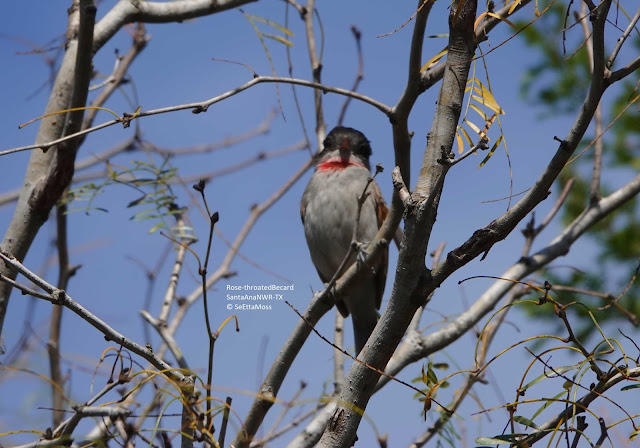
Another rarity, Rose-throated Becard

Image
Rose-throated Becards are very rare tropical species that have only been reported in Texas and Southeast Arizona. This male becard was found just a few weeks ago but there has also been sightings of a female type (fem/imm male) late last fall. This species occurs from Central America through much of Mexico. It is reported that these birds sit quite still for periods making them challenging to spot and with males like this one it is especially challenging if they are facing away from you or their heads are down so their bright rose colored throats. I was able to watch this bird for about 15 minutes as moved from tree to tree pausing often. It began foraging at about 15 feet above the ground but moved down to 4 or so feet into the shrubby vegetation. The bottom pic shows it flying away with the rufous feathers on it's wings evident. SeEtta A range map for this species is below.

Groove-billed Anis, unusual looking southern Texas specialty

Image
 I spotted this ani at Santa Ana National Wildlife Refuge as it was drinking water at the edge of North Lake. I came around a corner and it was only 10 feet in front of me but it quickly flew into the thick vegetation. After vocalizing it flew up into a tree where I got the top 2 pics.  I saw my first Groove-billed Anis in Costa some years ago but an experience that is still clear in my memory.  As I was wandering alone around the town of Monteverde so it was my own discovery not just a bird pointed out to me by a guide. I heard a second ani vocalize in the vegetation near the tree and the first ani flew in there providing me with the above photo.  Unfortunately the thick vegetation made getting a focused photo not possible but it was too neat to get 2 anis together to not include this pic.   The next day I returned to Santa Ana which was having Family Days with a number of activities including the opportunity to kayak on North Lake which...

Neotropical nightjar: Common Pauraque

Image
 I found this Common Pauraque at Santa Ana National Wildlife Refuge this morning. These are a specialty of the deep South Texas as this is the only location in the U.S. where this species can be found while it ranges through Mexico and down to South America.  Another species that blends in amazingly with the habitat in which it is found.  I think this may be a rufous type Common Pauraque and have done no post processing of these pics other than cropping to enlarge them in hopes that someone can confirm or disconfirm this.  The different shades of these pics I believe are due to the natural lighting which was going from clouded over to sun breaking through.  SeEtta

Groove-billed Anis--not just one, but 5!

Image
I really enjoy seeing Groove-billed Anis, a species that is most often in the Rio Grande Valley during spring and summer. But they are here some winters and this is one with reports of several birds in several locations. This morning I went to look for them at the Santa Ana NWR where up to 4 birds have recently been reported. I thought I had blown it because I found I got there that I had not put the memory card back in my camera--arggh, at least I looked before I left the parking lot. So I had to drive back to my motel to get it (it would have been almost as far and taken more time to go buy one). So after that return trip and checking in the Visitor Center for reports of sightings, I didn't get out birding until about 11 am. And I looked for about an hour and half with no results so was on my way back when I turned a corner and spotted something black on a tree in the thicket--yup, a Groove-billed Ani. Then it spotted me looking at it and flew off in the thicket follo...

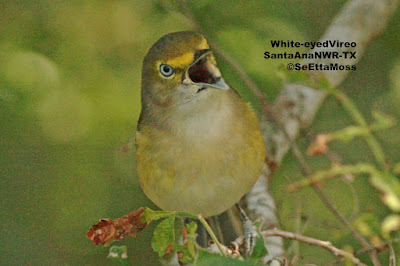
Sing,sing a song-White-eyedVireo

Image
I was fortunate to catch this White-eyed Vireo in song today at the Santa Ana NWR. I was on my way down the 'hawk tower' so for a change I was higher than this vireo putting me and my camera in a position to look right into it's wide open beak. SeEtta

Bright Great Kiskadees

Image
Fortunately the sun had come out by the time I photographed this Great Kiskadee at Santa Ana NWR today. It's bright yellow plumage shows so much better with sunshine. As brightly colored as they are, these beauties can hide in plain view by sitting still. But when they call, their voices carry and they can be heard at some distance. SeEtta

"Interesting hawk" is a Gray Hawk

I received several emails this morning about the hawk in my prior post that I found at Santa Ana NWR--all said it was a Gray Hawk. One of those was Tim Brush who is well known and highly respected authority on birds in the Rio Grande Valley (and probably elsewhere). SeEtta

Interesting hawk at Santa Ana

Image
I found this hawk this morning east of the Pintail Lake trail. Unfortunately the tree was perched in a tree well over a hundred feet away (more like 150 feet). Due to that distance, the mostly cloudy sky and my handholding the camera, I had to use a high ISO setting and fast speed so the pics came out pretty dark and I was unable to lighten them any better than as shown without distorting them. The hawk is blackish with a wide white band around the middle of the tail, a narrow white terminal tail band, it has a yellowish cere, wingtips are shorter than tail tip, and it appears to have long legs. These fit the description for a Common Black Hawk. Also it called and retrospectively it sounds like the call of a Common Black Hawk. What I have some problem with is the white feathers that can be seen in the last two pics that appear to be in the area of the upper legs that are whitish which are not consistent with extensive description of Common Black Hawk in Raptors of Western North Am...

Wintering Pine Warbler @SantaAnaNWR

Image
Today was the Christmas Bird Count at Santa Ana National Wildlife Refuge which is located on the border of Mexico. Though small by National Refuge size at about 2,000 acres, approximately 400 bird species have been seen there. Named for the pine trees that are their usual habitat, this bird was foraging in some mixed tree species. This Pine Warbler flitted in mid canopy about 60-80 feet above the ground and I took these pics-habndheld- from a distance of about 50-75 feet. With reduced lighting in the trees, the pics came out fairly dark but not good enough to lighten them more. SeEtta

Colorful female Painted Bunting

Image
This female Painted Bunting was foraging in the same location as the male pictured in the post below. Though her plumage is not as brilliant as that of the male, she was still quite colorful with her bright greenish feathers. She was less reticent than the male so I got to watch her for several minutes and got several pics. A few blue feathers on the shoulder area and a few around the head area show up in several pics. Birds of North America online states that females in Basic I plumage may have blue feathers on their heads. This female and the male Painted Bunting, in addition to foraging close together, interacted at one point. This makes me wonder if they are paired-up. SeEtta

Gorgeous Painted Bunting

Image
I found this male Painted Bunting at Santa Ana NWR today. These guys are one of the brightest and most colorful landbirds that we see in the U.S. Do double-click on the pic to enlarge it--the close-up is even better. SeEtta

Cool spiders

Image
This morning I birded Santa Ana National Wildlife Refuge. I have birded it a little this time but today I targetted the Groove-billed Ani, a unique species that I have found every time I have birded the Rio Grande Valley but had missed so far this trip. I had to walk over a mile and a half to get to the area where these birds had recently been seen but it was worth it as I did find one. And it vocalized for several minutes, something I have never heard before. Unfortunatel it did not provide any opportunity for a photo. As I walked the dirt and grass covered paths, I saw a number of spiders spinning their webs or working their prey at face height or higher. Though Santa Ana is best known for it's birding, it provides a unique habitat including tropical deciduous forest as well as spiny shrub habitats, that are home for a variety of wild and interesting critters. This is one of those interesting spiders. It is a Spiny Orb Weaver spider, a beneficial insect. SeEtta