Posts

Showing posts with the label SnowyEgrets

Cattle Egrets, both breeding and nonbreeding plumage
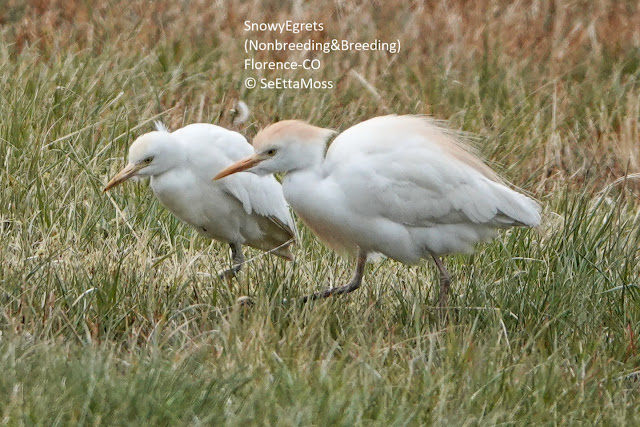
Image
I found these Cattle Egrets, one in nonbreeding plumage and the other progressed into breeding plumage, feeding together in a flooded agricultural field in the south central town of Florence. They have provided an opportunity to view these two plumage stages side by side. {Click on Read More to read the rest of the description and see more pics} The bird in both the pic above and below is the Cattle Egret in nonbreeding plumage. Note the very small amount of buff colored feathers and it's blackish legs (best seen in pic below), characteristics found on nonbreeding birds. The light buff on it's crown may indicate it has begun transitioning into breeding plumage. The bird in the pic above has transitioned to a large extent into breeding plumage showing a lot of buff colored feathers on it's breast (shows in top pic) back and head. However it's legs are still fairly dark so still transitioning yellow or pink legs seen on this species during breeding season. SeE...

Egrets at Quivira NWR

Image
These are some of the many egrets that were still at Quivira National Wildlife Refuge in early October as I meandered my way home through Kansas. The egret in the top pic is a Cattle Egret that was feeding in the vegetation right next to the road. The wild-child Snowy Egret in the middle pic was suffering a bad hair day due to strong winds. I took the bottom pic of a Snowy Egret with beak wide as it hunted in a slough adjacent to the road. SeEtta

White as Snow-y Egrets

Image
As white as the feathers of Snowy Egrets are, it is their contrasting black legs and yellow feet that make them readily distinguishable from Great Egrets even when flying away and their distinguishable bills are not visible. The yellow bare skin on their lores (areain front of eyes) is visible in the top pic. These two Snowy Egrets were foraging along the Rio Grande River in the town of Alamosa, CO. Snowy Egrets breed in the San Luis Valley and I saw them in a number of locations including a group of 11 feeding together in a flooded field with 75 or so dark Ibises. SeEtta