Posts

Showing posts with the label HolcimWetlands

Holcim Wetlands flooded by Arkansas River

Image
The Holcim Wetlands have been flooded for the second consecutive year, this time by flooding of the Arkansas River which has reached above it's banks due to big rains and lots of snowmelt. As can be seen in the bottom pic (outlined in grey) the bank has totally been demolished in one section so that the river is just running right through the wetlands and the wetlands are no longer separated from the river in that area. Due to the flooding it is closed and will be for some time. Very unfortunate as this is has a history of some very rare birds including previous breeding Least Bittern. SeEtta

Possible Roseate Skimmer dragonfly at Holcim Wetlands

Image
A few days ago a skilled birder and naturalist, Tony, found a dragonfly that is very rare in Colorado having only been seen on 4 occasions. As I birded my way back home from Pueblo,CO today I stopped at the Holcim Wetlands. I think I refound that dragonfly which is a Roseate Skimmer. The other dragonflies I saw were Pondhawks, at least one each male (blue) and female (green) and a number of bluets. So the purple-pink colored skimmer caught my attention as it sparred with the Pondhawks. Not only was it's abdomen purple-pink but so is it's thorax (looks dark in pic but was just as bright purple-pink as it's abdomen. This dragonfly was large, similar in size to the Pondhawks. The wings show the same pattern as shown on the photos of Roseate Skimmers on Bug Net . SeEtta

Another pic of Great Bluer Heron nestling

Image
For a super close up view, double-click on the pic to enlarge it. I took these pics with my digital SLR camera with a 400 mm lens and a 1.4 extender--combining that with the multiplier of 1.6 because it is not a full frame camera, I am shooting the equivalent of close to 900 mm. It is unethical to approach nesting herons or other birds too closely--they do flush from their nests when humans are close (which I observed this week when the owner of some cattle that had strayed into the area walked right underneath the nests) which puts eggs and very young nestlings in danger from the elements. Also Great Blue Herons as well as other birds do abandon their nests and nestlings due to too much disturbance. If you want good photos of these birds it is your obligation to get the photo equipment that does not put the birds at risk.

Great Blue Heron nestlings

Image
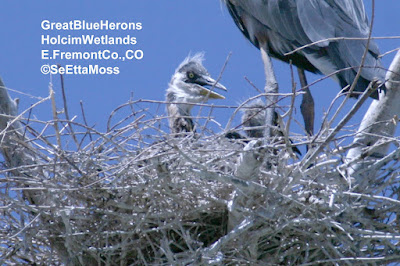
For super close up views, double-click on the pics to enlarge them. These Great Blue Herons are in rookery that nests in large cottonwood trees in Holcim Wetlands in eastern Fremont Co., CO. This year a group of Double-crested Cormorants began nesting there also. The nestlings in these pics are young. They won't begin to fly until they are 50-60 days of age but at least one was already learning to extend it's wings and make a few flapping motions while I was there. SeEtta

Tricolored Heron-another short video clip

This very short video clip is a little difficult as the Tricolored Heron is behind tall cattails and the video camera does not always focus well as it moves quickly about but it provides a view of how the heron engages in 'dart' feeding. It is probably best to run it at least 2 times to see the heron as it is moving rapidly through most of the clip and the picture shakes as I have difficulty holding the camcorder totally still when I have it extended to it's full 40X optical zoom. At the end the heron is standing still behind the cattails. SeEtta

Tricolored Heron video clip

This video clip shows the Tricolored Heron as it does some fishing along the edge of the cattail marsh. SeEtta

Tricolored Heron-a rare vagrant in Fremont Co., CO

Image
This Tricolored Heron was found yesterday by local area birder Rich, at the Holcim Wetlands in eastern Fremont County, CO. Probably a first for the county, it is also a rarity throughout Colorado. When I arrived the sun was shining and only starting to get cloudy when I got the top pic. I sat and watched the heron for about 10 minutes and by the time I got the bottom pic it had started to rain so that pic is not as bright and sharp as the top pic (demonstrates the difference that light makes). However it does show it's distinctive white belly. I enjoyed watching this heron make several 'dash' moves to go quickly after prey--a very fast effort I might add. Though I was enjoying observing this heron feed, I took off shortly after this pic as it started thundering. SeEtta

Peregrine Falcon head features

Image
This pic was nice at showing the the head of a juvenile Peregrine Falcon. Important field marks that can be seen in this pic are the blue cere and orbital skin--these change to yellow beginning in the winter of the bird's first year. Also the streaking on it's chest is a field mark for juvenile Peregrine's (while adults have spotting and barring). SeEtta

More juv. Peregrine Falcon pics

Image
I believe it had field marks consistent with a juvenile "American" (F.p. anatum) Peregrine Falcon described in detail in Brian Wheeler's Raptors of Western North America (p. 474--not the 'lightly marked type'). Field marks consistent with this subspecies that are evident in these pics include: a 'wide type' malar mark that blends with it's dark cap; a dark forehead with a "narrow tawny patch"; nape is a mix of dark coloration and some pale patches; it has tawny auriculars; the ventral part of it's body is "rufous-tawny with moderately wiede dark brown streaking on the breast, belly and lower belly"; the flanks I could see well are streaked; the leg feathers are tawny with pretty wide markings (Wheeler says "streaking" but that isn't clear in my pics); the dorsal portion of the wings are dark brown and there are tawny colored edging on the coverts; the ventral portion of the remiges are dark with pretty wide rufous ...

New Peregrine on the block

Image
Today while checking for late nesters on my Colo Breeding Bird Atlas block east of Florence,CO, I saw this juvenile Peregrine Falcon fly down the Arkansas River and into some adjacent cottonwood woodlands in pursuit of a meal. It apparently was unsuccessful and perched in a tree where I took some of these pics. While perched, the apparent resident Redtail Hawk flew nearby calling it's displeasure at this competition in it's hunting grounds. Though the Peregrine didn't leave, it was clearly paying attention as it moved it's head in a manner I have seen done by Great Horned Owls which was amusing when done by a falcon. The juvenile took off two more times and attempted to catch a bird but still unsuccesful. It's a hard life for juvenile raptors learning how to hunt. Most of these pics will enlarge for nice close-ups so just double click on each pic to really see the field marks well. SeEtta