Posts

Showing posts with the label FlorenceRiverPark-CO

"Hidden" Belted Kingfisher

Image
I photographed this Belted Kingfisher at Florence River Park from my car.  As the bird was behind a number of tree and shrub branches it thought it was hidden so it stayed put about 30 feet from my car (they usually flush at that close distance)--of course those branches made getting a clear shot a challenge. While field marks of blue-gray  head and back, white collar, black dagger like bill are usually noted, often not mentioned is the small white  spot in front of each eye.  Interestingly these white spots are thought to assist their fishing skill:  "That “perfect” aim, some biologists believe, is enabled by two white “false eyes” in front of the bill. These spots may serve as sighting devices along the line of the bill, allowing the eyes to fix binocular vision on the prey, and also correcting for light refraction at the water’s surface, which makes prey appear to be nearer the su...

Stopover by Snowy Egret

Image
I found this Snowy Egret at Florence River Park last week. This is the first of the year Snowy Egret I have seen. It didn't stay long so likely was just stopping over as it migrates. Birds of North American online provides a wonderful description: "Adults in breeding plumage develop long, delicate plumes forming wispy spray of feathers extending off breast, recurving off lower back (arising from lower scapulars), and forming short, shaggy crest off nape." Click on Read More for more pics SeEtta

Rescuing a young hummingbird nestling

Image
Yesterday I drove over to Florence River Park, a small nature park on the far east edge of Florence, CO. As I sat in my car for a few minutes I spotted a hummingbird 20-25 feet in front of my car. It hovered a few feet off the ground then went down to the ground which piqued my curiosity. When I got it in my binoculars I was stunned to see that it was on the ground feeding its baby. And, ye gads, it was in the parking lot where it was could be run over by a vehicle, grabbed by one of off leash dogs that are common here or even stepped on by someone as it was difficult to see. So I got out to move it, or get to move on it's own if it was able to fly, to a safer location. The pics above and just below show the young hummer on the ground in the parking lot. It quickly became apparent this was a nestling that was not ready to fledge yet. I called Nancy Kelly at Second Chance Wildlife Rehab in Pueblo to ask her advice. She advised putting it back in the nest which was not p...

White-throated Swifts stop over to feed on migration

Image
I enjoyed watching a migrating flock of  about 50 White-throated Swifts engaged in frenzied breeding along the Arkansas River near the Florence River Park. I have observed similar feeding flocks at this location in previous years as they make their way to locations further west with cliffs. Fyi-these pics are good enough quality to be enlarged for better viewing, just click on each pic. I wonder if some of these are on their way to the Royal Gorge just west of Canon City and only 20-25 years west of this location.  SeEtta

Snowy Egret migrating through

Image
  I let my dog Chase out of the car and then realized there was this Snowy Egret less than 50 feet away.  This is likely one of the two Snowy Egrets I had spotted flying earlier in the area. As my area of Colorado is semi arid we have few water bodies or wetlands so we don't see many egrets.  Though Snowy Egrets nest in a few isolated areas in 2 adjacent counties they have not been found nesting in Fremont County.

Eastern Phoebe gathering nesting material

Image
  I spotted this Eastern Phoebe in Florence River Park (at the far eastern end of Florence,CO) today.  This is the first time I have seen this species here but I have been under walking restrictions for my knee so I have done little walking here for awhile.   The phoebe is holding grass stems or other plant fibers in her bill.  I say 'she' as in Eastern Phoebes it is the female who exclusively builds the nest.  I spotted a second phoebe and on close inspection that bird looks to be a hybrid Eastern X Black Phoebe.  For those unaware there have been many hybrid nestings in the Canon City area of these two species and they have produced a number of offspring that have fledged.   I wasn't able to get a pic of that bird but will try to do so soon. SeEtta

More Black Phoebes in Canon City and surrounding areas

Image
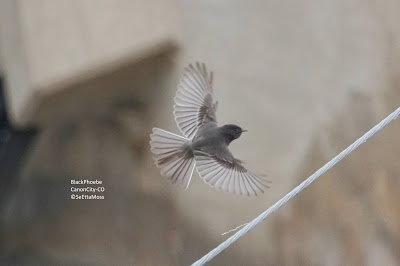
The top pic is one of a pair of Black Phoebes that I have for the past week or so on a friend's property just east of Canon City. These other two pics are of a single Black Phoebe I spotted at Florence River Park. SeEtta

Belted Kingfisher

Image
I photographed this female Belted Kingfisher at Florence River Park, a small local park in Florence, CO adjacent to the Arkansas River. The bottom pic is not very sharp but I included it since it shows that the rusty belt runs from the chest to the sides and up onto the underside of the wing. SeEtta

Very large flock of migrating Common Nighthawks

Image
If you enlarge the pic above (just click on it) there are more than 60 Common Nighthawks in that one photo. All in all this flock of migrating Common Nighthawks totaled at least 75 and more likely 100 birds--absolutely the most nighthawks I have ever seen at one time. Click on this second pic also to see identifiable nighthawks. When I first spotted this flock they looked like a river of birds in the sky and I thought it must be a flock of gulls as I have seen similar flocks flying kind of in a line that were gulls-and I couldn't imagine it was a flock of nighthawks, a species that has been in decline and that I have seen in smaller numbers here year after year. Though they generally headed down the Arkansas River corridor, smaller groups of them would fly around the area as they foraged. I think the most I have seen before migrating through here was around 12 in 2014 (they flew lower so got better pics).   This was just an amazing spectacle. SeEtta

Spotted Sandpiper chicks getting bigger

Image
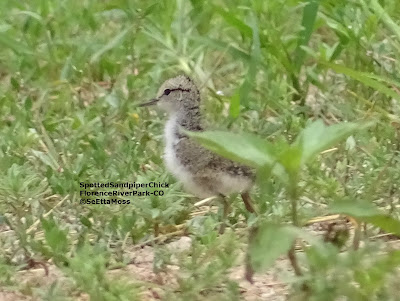
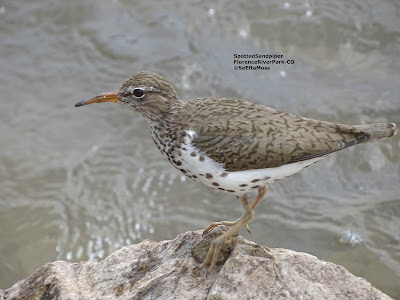
I continue following the Spotted Sandpiper parent and when possible it's chicks. Over the week-end the parent, who gives warning calls for the chicks to hide when it is concerned, allowed one of it's chicks to come out from the heavy vegetation to learn how to walk along the edge of the river and forage there. I stood very still about 35-40 feet from where the chick was located to get these pics with my long zoom lens. And the chicks have certainly grown taller since I last saw them just 4 days before. Nevertheless the parent bird stayed nearby clearly watching over it's offspring. The pic just above shows the sparse feathering where a tail is growing--they just look like fuzzy-butts. The bills on the chicks are also growing quite a lot both in length and width though clearly much smaller than the parent's bill. And finally yesterday both chicks were out from the thick vegetation and I got the bottom 3 pics of that chick (they are the same size and look j...

Silver-spotted Skipper

Image
Another critter I photographed at Florence River Park, this member of the skipper family of butterflies [ "Skippers have large eyes, short antennae (often with hooked clubs), stout bodies, and three pairs of walking legs "] was perched near their wetland area. Though the descriptions of this Silver-spotted Skipper state that the patch on it's hindwing is silver or silver-white from which it gets it's name, it looked whitish in the field just as it does in this pic. SeEtta

Band-winged Meadowhawk, female dragonfly

Image
I photographed this female dragonfly, a Band-winged Meadowhawk, at Florence River Park this week. "This meadowhawk is named for the band of amber color near the base of the wings." (from http://thedragonflywhisperer.blogspot.com/2013/09/band-winged-meadowhawk.html). The males are red and females like this one are yellowish. Band-winged Meadowhawks are approximately 1- 1.5 inches in body length with wings about 2 inches across (from https://en.wikipedia.org/wiki/Band-winged_meadowhawk). SeEtta

Spotted Sandpiper Chicks, 3 more days older

Image
Two days when I went to check on the Spotted Sandpiper family at Florence River Park I thought they had likely perished--there were two men engaged in gold panning right where the parent sandpiper had been and they had dug some of the sand from the bank where I last saw the sandpiper chicks. Arggh, I was afraid that all this activity, plus a large off leash dog with these people, would have scared the parent away and even if the chicks were successful in hiding in the vegetation they would not survive without a parent at their young age. What a surprise when I returned that evening for one last check to be accosted by the parent sandpiper calling loudly and challenging me by walking right towards me (and my dog). It took awhile for the parent to settle down and for one of the chicks to walk in some grass where I could spot it--the parent had moved the chicks about 150 from the river into an area with a lot of vegetation. I returned day before yesterday and refound the parent and ...

Video clip: Protective parent Spotted Sandpiper

Agitated Spotted Sandpiper from SeEtta Moss on Vimeo This is the parent Spotted Sandpiper that gets agitated as I try to walk the trail past where it's chicks are hidden. Unlike Killdeer it does not try to track me away from the chicks but comes right towards me. At the end of short clip it gets even closer as it flies past me. Once it flew past I walked on away from the area. SeEtta

Tiny Spotted Sandpiper chicks

Image
I had to sneak up and sit, partially hidden from the parent, about 35 feet from where I watched the Spotted Sandpiper chicks in order for the parent bird to let these chicks come out from inside the vegetation where I could watch and photograph them. The parent continued in a state of alert and called the chicks back into hiding several times when other park users walked by. I was able to see two chicks together at one point but not sure if there may have been more as otherwise I only saw one at a time, and then usually at least partially obstructed by some vegetation. I was surprised to see such young chicks already doing the Spotted Sandpiper teetering. I am more amazed to read in Birds of North America (BNA) online that this begins within 30 minutes of hatching-these are indeed a precocial species. As I watched the chicks spent a lot of time in the cover of vegetation but when in view they would peck on the ground. BNA says they begin feeding themselves about 2 hours aft...

Very agitated Spotted Sandpiper

Image
I walked the trail around Florence River Park this morning for the first time in awhile. Not only have I not been able to take this on but this park was closed for much of the past few months due to the extensive rains and river flooding in the area. As I walked the trail alongside the Arkansas River I heard a Spotted Sandpiper call. I stopped to look for it--unnecessary as this bird came flying close and calling in a very agitated manner. Clearly not the normal Spotted Sandpiper actions I expected this was an indication the bird had a nest nearby. This sandpiper was so agitated and aggressive for this species, flying within 8 or 9 feet of me, I retreated a distance to watch. That took a little while as this bird was quite suspicious and even flew back onto the trail looking to see if I was still around (wow, never would have thought s Spotted Sandpiper would stalk me). It took a full 10 minutes for the bird to decide it was safe and it went into some vegetation near the wate...

Snowy Egret doing the 'foot shake' to stir up fish to catch

Image
SnowyEget doing' foot shaking' fishing technique from SeEtta Moss on Vimeo In this brief video clip this Snowy Egret engages in a fish catching technique in which it shakes it foot in the water to stir up fish to catch. It starts just at 11 seconds into the clip and it shakes first one then the other foot several times apparently producing a catch for it which it quickly consumes. It is interesting what techniques various bird species have learned to improve their foraging catch.  SeEtta SnowyEget doing' foot shaking' fishing technique from SeEtta Moss on Vimeo .