Posts

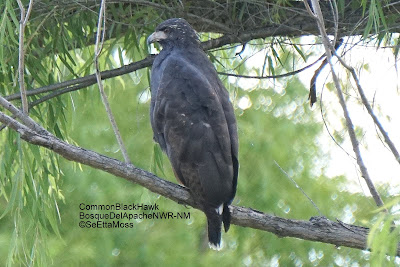
Common Black Hawk at Bosque del Apache NWR
Image
I spotted this Common Black Hawk perched in the branches of a tree as I drove around the road on the east side of Bosque del Apache National Wildlife Refuge this afternoon.  It is amazing how that black plumage blends in with the habitat.  Common Black Hawk is a pretty rare species whose range in the U.S. is limited to restricted areas of the Southwest.  Birds of North America online states, "... total U.S. breeding population estimated 220–250 pairs." A search of Ebird shows two sightings of this species at Bosque del Apache in the past month, presumably this same bird. That said a Common Black Hawk was vagrant in my town of Canon City, Colorado for a month in 2006 followed by a short visit in 2007.  You can see that bird on my post about it on my SE Colorado Birding blog that I ran prior to this blog. SeEtta

Very large flock of migrating Common Nighthawks

Image
If you enlarge the pic above (just click on it) there are more than 60 Common Nighthawks in that one photo. All in all this flock of migrating Common Nighthawks totaled at least 75 and more likely 100 birds--absolutely the most nighthawks I have ever seen at one time. Click on this second pic also to see identifiable nighthawks. When I first spotted this flock they looked like a river of birds in the sky and I thought it must be a flock of gulls as I have seen similar flocks flying kind of in a line that were gulls-and I couldn't imagine it was a flock of nighthawks, a species that has been in decline and that I have seen in smaller numbers here year after year. Though they generally headed down the Arkansas River corridor, smaller groups of them would fly around the area as they foraged. I think the most I have seen before migrating through here was around 12 in 2014 (they flew lower so got better pics).   This was just an amazing spectacle. SeEtta

Young Rufous Hummer

Image
This is an immature Rufous Hummingbird that stays in my neighborhood and feeds daily on pollinator plants in my yard. All the hummers really like this Sunset Agastache rupestris (Licorice Mint Hyssop) that has trumpet shaped flowers.  In the top pic this hummer was perched on a leaf on the Agastache plant then just leaned over to sip the nectar from flowers nearby.

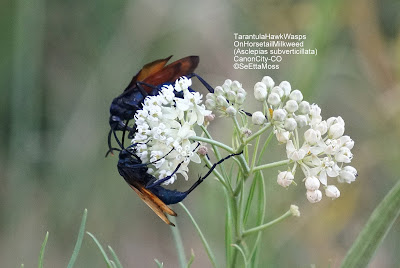
Tarantula Hawk Moths on pretty native milkweed called Horsetail Milkweed

Image
I found a bunch of this native Horsetail Milkweed (Asclepias subverticillata) in the far west part of Canon City. While Horsetail Milkweed is listed as native in Colorado the 'Floristic Synthesis of North America' lists it as a 'Native Species, but adventive in state.' Had to look that up--'adventive species' refers to "a species that has arrived in a new locality" which may have been with help of people or it may not (ie, range expansion). As a native milkweed it is an important plant for Monarch Butterflies as well as other insects. These Tarantula Hawk Wasps (Pepsis sp., Pompilidae) are some of the largest insects in the U.S. "When a female is ready to lay her eggs, she seeks out a tarantula and injects it with paralyzing venom. She drags the tarantula to a burrow and stuffs it down the hole, then lays her eggs on top of the paralyzed spider. Several days later the eggs hatch and the larvae feed on the still living tarantula." (ht...

Lark Buntings beginning to gather for migration

Image
In southeast Colorado this past week I found several small groups of Lark Buntings including this one that appear to be gathering for migration. This is a female and I believe she is at least partially in her winter (definitive) plumage (per Birds of North America online, "Plumage similar to Definitive Alternate female, except in fresh plumage, pattern more blended, appearing less grayish brown and more strongly tinged with buff; middle secondaries (S4–S6) edged rusty; and chin without black.") SeEtta

Olive-sided Flycatcher migrating through south central Colorado

Image
8-14-16 correction--I stated below that landbird migration had begun but this was corrected by the following post on Cobirds listserv by Tony Leukering: >> I spotted this Olive-sided Flycatcher this afternoon as it sallied out after insects at Brush Hollow State Wildlife Area just over 10 miles northeast of Canon City. Since this species does not breed in this lower elevation it has stopped over to feed on it's migration south. With indistinct wing bars it appears to be an adult bird with worn plumage ( Sibley says they do not molt until they are on their winter grounds so adults have feathers almost a year old). Like many/most fall flycatchers it was silent but it's clear vested underparts, big head and short tail make it easy to id as an Olive-sided. Landbird migration has begun. SeEtta

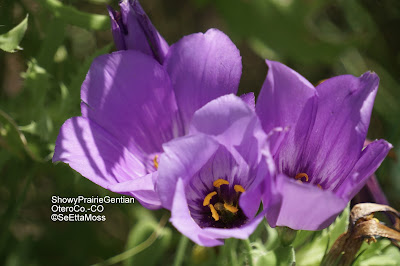
Showy Prairie Gentian, a field filled with this rarish native wildflower

Image
I spotted these neat wildflowers several years ago in a pasture in Otero County that often has cattle grazing in it. After I found out these were rarish native plants I was going to try to learn more; but we went into drought conditions in southeast Colorado and though I have looked each year they did not grow again until this year. And this year thanks to some good precipitation in that area they are flourishing. This is the largest area covered with them that I have seen. The Colo Natural Heritage Program , which lists them in their rare plants database, describes their habitat as follows: "Along streams; in wet meadows, pastures, and fields; usually near old stream meanders or at the margins of lakes or ponds. Often in alkaline soils. Elev. 3500 - 6000 ft." The map on the Colo Natural Heritage Program site does not show them in Otero County but it looks like it may not be updated as the most recent reference is 1989. I will make some inquiries to see if there ...