Posts

Image
As can be seen in the top pic, this bird is attempting to pick up food with it's damaged bill though I cannot imagine how it can feed itself with the position of the upper and lower mandibles as they are. The bird let me approach on foot relatively close (40-50 feet) and once I got close enough to see the bill well I realized it might be doing so because it is very hungry. So I took my photos where the bird was (in lieu of waiting for it to move to a less trashed up (with beer bottle) location and backed away to let it try to feed. It would seem unlikely to survive to adulthood (I believe it is an adult female in breeding plumage) with it's bill like it is so wonder if it could have run into something and bent the bill (it has some enlargement on the top at the base of the bill?). SeEtta

American Golden-Plover, a sad sight

Image
Earlier this week I traveled to the lower Arkansas Valley to do some birding during a brief respite (only a few days) in the 100+ temps they have had from Pueblo to the Kansas border. Due to the continuing drought, all the lakes including Lake Holbrook were very low. As can be seen in this photo there were fish around the lake edges as they were dying due to low water and hot temps which increases the water temps and reduces oxygen levels. Along with the sad state of hundreds of dead and dying fish, I spotted this American Golden-Plover, a rare visitor to Colorado, and it had a damaged bill as can be seen in this photo. I suspect this poor bird was here to try to feed on the insects drawn to all the dead fish. More photos to follow. SeEtta

Last climbing kestrel pic

Image
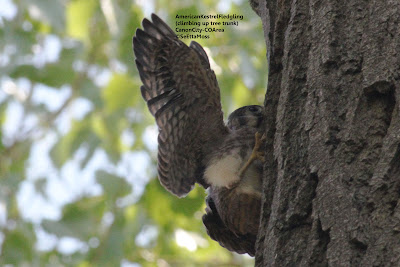
This photo provides a better view of the young Kestrel's claws clinging to the bark of the tree trunk it is climbing. It appeared to use it's tail for balance similar to how woodpeckers do. Since young Great Horned Owls that climb tree branches when they first leave the nest are called 'branchers', could these kestrel's be referred to as 'trunkers'?-lol. SeEtta

Am Kestrel fledgling, more pics on tree trunk

Image
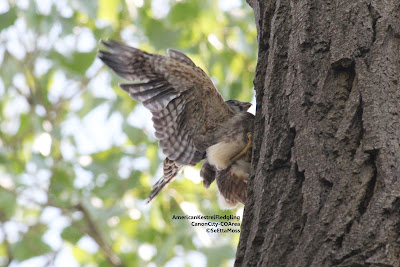
The top pic shows the American Kestrel fledgling as it is hopping up the tree trunk while using flapping it's wings to assist it in climbing up the tree. This was most unusual to observe. SeEtta

Am Kestrel fledgling-climbing up a tree!

Image
I had previously observed a pair of American Kestrels that I thought were nesting in a cottonwood grove between the Arkansas River and a hay field on my friend's organic farm in the Canon City, CO area. Today I found this young fledgling clinging to the trunk of one of the large cottonwood trees in this grove. As it climbed the tree, hopping up with the help of it's wings, both apparent parents flew around and called often. More pics to follow. SeEtta

More pics of Grace's Warbler

Image
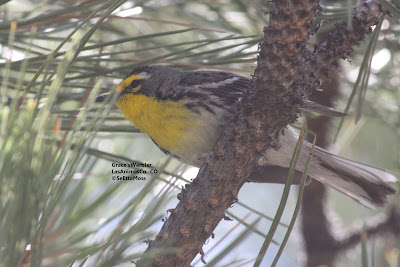
The top photo was almost full screen. And I like to add photos with back views, that are eschewed by most photographers, since most of us see birds from behind as well as from the front so helpful to see how they look from that view. I might add that I was concerned about whether this population of Grace's Warblers had been impacted by the very dense gas drilling (fracking)that has happened in that area as I haven't been up there in several years. There were gas wells peppered throughout this ponderosa forest and I could hear them as I drove through the area and also when I was watching these birds. It isn't possibly to know if there have been impacts as this population has never been surveyed so can't know if there are fewer now--sad that we have so little info about so many birds. SeEtta

Grace's Warbler, very close-up

Image
After I snapped a couple of photos of the bird in a conifer 80 feet away, it flew right into a tree near where I was standing. Instead of being bothered by the mechanical noise that my dslr camera makes when I take a photo it actually appeared to be drawn to it as it came so close in the tree that I couldn't focus my big telephoto lens set-up. So I was able to get some unusually close photos which I only cropped a little to bring up close and personal. I suspect that the fact these birds are located so distant from most birders (it is almost a 3 hour drive for me) that they have not been previously exposed to being photographed and aren't disturbed by many people. There are lots of gas wells and this areas has many large acreage ranchettes but since these small warblers are often high up in conifers there are likely not often even seen by people. SeEtta