Posts

Dragonfly: Blue-eyed Darner

Image
I took these pics of this brilliant colored member of the dragonfly family, aptly named Blue-eyed Darner, as flew from one end of a small wetland to the other end and then back. Like others of it's kind, it spends a lot of time patrolling it's territory and chasing interlopers away. My experience with this species is the same as noted on MonterayBay.com : "Perched darners are rarely observed. . . ." and "Dragonflies are difficult to photograph in flight." Indeed--just as soon as one starts to hover in one place and I put my camera up to my eye, it darts off. Since they often are flying in and out of shadows, then sun, camera settings have to be reset. And since they are moving, the focus has to be continually focused (I find that automatic focus is worthless with moving dragonflies as well as moving birds). I find that in super close-up views this species has a funny face--the large blue ovals are indeed it's blue eyes and it looks like it has a da...

Barn Swallow fledgling: Make my day

Image
This recently fledged Barn Swallow just looks like it's saying "being of the nest isn't all it's cranked up to be so just go ahead and make my day."

Paxa, the picky California Condor

Image
I reported in an earlier post on efforts to save California Condors in the rescue program from the wildfires last month. I just saw this information about the interesting personalities of some of the captive condors including the one in this pic, Paxa. He is a male condor and is productive breeder. But he has an interesting habits as he is very particular about his nesting space. Paxa even engages in his own version of interior decorating by adding various items to his nesting area including a calf leg (I suspect that was a left-over meal), a rabbit spine (also left over from a meal), and some large primary feathers. It is reported that when Paxa is preparing his nest room for the upcoming breeding season that he spends hours getting everything just right. You can read more about the condors in the Oregon Zoo Conservation program here . SeEtta

"Cicada killer" wasp with a "dog day" cicada in it's grasp

Image
Even if you really don't like insects, I think that the ferocious look of this member of the wasp family is compelling. I can really see this used as some monster in a sci-fi flick. I saw this very interesting insect flying with a cicada in it's grasp and landing on the hood of my car in some stormy winds at Lake Cheraw. Aptly named "Cicada killer" as that is what they do, not to feed themselves but to feed their young (they feed on sap and nectar). "Cicadas are captured, paralyzed by a sting and used for food to rear their young. After stinging a large cicada, the female wasp drags it up a tree, straddles it and takes off toward the burrow, partly gliding. When trees are not available, the cicada (prey) is dragged to the burrow on the ground." (Ohio State Univ extension factsheet). Due to a storm in the area, the winds were blowing hard and this wasp had to fight hard to keep from being blown away, but it clung tightly to the cicada, a "dog day...

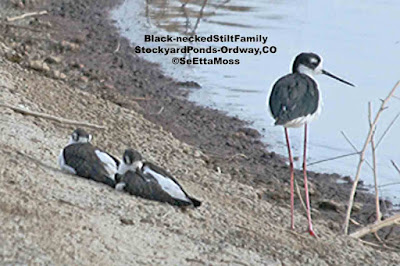
Black-necked Stilt family

Image
These pics are not the greatest because I didn't want to stress the parent bird by getting closer or staying longer to get better shots as I don't believe that recreational photography or birding justifies such intrusiveness. I was surprised the parent bird was disturbed by my presence since I was over 100 feet away and I stayed inside my car, but some species and even some individual birds are more sensitive than others. The he parent Black-necked Stilt is standing near her offspring in the top pick. Even with it's poor quality it shows well the reddish pink legs that is an indicator of adult females per Birds of North America (BNA) online. Juveniles have brownish irises and "Juvenal plumage has similar pattern to adult but dark feathers of upperparts brown with buff margins creating a scalloped effect" according to BNA. This scalloping effect can be made out on the two juveniles (both sitting on their legs). The pale legs of the one juvenile are clearly s...

Baby Virginia Rail

Image
For those unfamiliar with rails, they do indeed seem to measure up to the saying "skinny as a rail"--that came from those who watched rails turn sideways and disappear into marsh vegetation as though they were as thin as a piece of paper. I have been watching b Soras (also a rail species)in a marsh at my friend's for the past week but today was the first time I saw a Virginia Rail (at least this year as I watched both species in this same marsh last year). I saw an adult Virginia Rail foraging close to the edge then spotted this juvenile further back in the reeds. It had apparently been following its parent but did not move as close so I shot these pics (handheld as I didn't bring my tripod) though the reeds from about 20 feet away. I believe this young Virginia Rail is about 2 1/2 to 3 1/2 weeks old. Though it's bill is becoming black, there is still some white and pink around the nasal septum and at the tip, which is noted in Birds of North America (BNA) onl...

Juvenile Sora Rails

Image
I have been listening to Sora rails calling in several marshes at my friend's near Canon City and have caught glimpses of them. Finally I got these pics of a juvenile Sora Rail. Though their plumage is similar to adult Soras, they do not have the black lores and forehead present on adult birds, their chin/throat area is whitish instead of black and their breast and lower throat area is brownish instead of the grey coloration on adults. This rail is more than 5 weeks old as Sibley states that they retain a red cere util that time and it is clearly not present on this rail. SeEtta