Posts

Adult male Vermilion Flycatchers are the quite striking

Image
Like many adult males those of the Vermilion Flycatcher species are brightly colored. This fellow was foraging at Anzalduas County Park. SeEtta

Vermilion Flycatcher, very close up

Image
It was crummy weather, mid 30's and drizzling when I spotted this Vermilion Flycatcher at Anzalduas Park. The bird's feathers were pretty wet which caused them to stick together in some areas. Instead of sallying out to catch insects in flight it was foraging on the pavement. So I drove slowly near it and parked about 40 feet away. And I stayed in my car to photograph it using my car as a blind, a technique I use a lot as it reduces disturbance to the birds. After watching the bird several minutes it flew near by car and proceeded to forage on the pavement within 10-15 feet from me. I used the silent setting on my camera (while I don't hear any noise I have seen some birds reacting so there is apparently some sound that is audible to them, but this bird did not show any reaction to my shots). I couldn't see what the bird was pursuing but it sure worked hard at it. And I got some nice close up pics. SeEtta

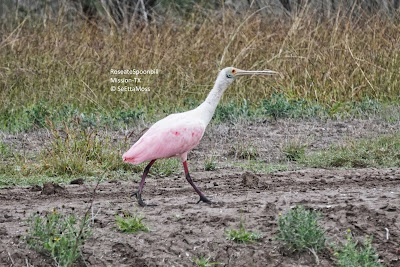
Roseate Spoonbill

Image
I found this Roseate Spoonbill walking along a canal at the Mission Nature Park. "Like many other bird species with beautiful plumage, roseate spoonbills were nearly hunted to extinction during the 1800s. Their striking pink feathers were popular on women's hats, and hunters from all over the United States competed for spoonbill plumes. In the early 1900s, roseate spoonbills began to recolonize areas along the Gulf Coast and slowly increase in number. Today, threats to roseate spoonbill populations come as a result of habitat loss." (from Texas Parks and Wildlife website) SeEtta

Rare for the LRGV, a Hammond' Flycather

Image
This Hammond's Flycatcher was identified yesterday at Estero Llano Grande State Park in Weslaco, TX by Mary Gustafson with some notes that this bird has been around for a month (I guess the bird matches some photos taken last month but identified as another species). There are very small differences between Hammond's and Dusky Flycatcher and similar to other empids. This bird wagged it's tail upwards which rules out Gray Flycatcher that wags it's tail downward. Sibley notes that Dusky has a rounded head and this bird shows a flatter head.  Sibley also differentiates Dusky and Hammond's by primary projection with Dusky having a short projection and Hammond's a long projection. Not visible in pics but I looked at the bird 's back and had the impression of a long primary projection. Sibley also states that Hammond's have a "distinct 'vest'" and all 3 of these shows a vested appearance. But I am glad there have been no other fl...

Is this Peregrine Falcon is giving me the finger!

Image
While I photographed this Peregrine Falcon it lifted it's foot and pointed it's middle toe directly up in the air and it's looking down towards me! Well, maybe not it's 'middle toe' (they have two toes facing forward and 2 back behind so they don't really have a middle toe). In the pic above it's 2 forward, 2 back toes are evident. And actually those are called talon. Check out those long,sharp nails! SeEtta

Black-throated Green Warbler at Quinta Mazatlan Birding Center

Image
I spotted this Black-throated Green Warbler at Quinta Mazatlan Birding Center. It shows the bright yellow face with olive auriculars but little of the black colored throat found on males of this species. Instead the small amount of black on the throat is indicative of a female or immature bird. Photos show the white belly with blackish streaks on the side that are also field marks of this species. SeEtta

Handsome Gray Hawk

Image
I spotted this Gray Hawk on a utility line next to Military Highway south of Pharr,TX. It spent it's time watching mostly on the ground below it for something presumably to eat. Gray Hawk is a tropical species found only in a few southwestern states bordering Mexico and mostly right along the border. They are one of the specialities in the Lower Rio Grande Valley of Texas. As it is noted that this species mainly eats small birds and lizards I suspect it was watching for lizards in this location next to the very busy Military Highway. It seemed odd to me to see this tropical hawk amongst all this urban utility wire clutter.  SeEtta