Posts

Phainopepla at Percha Dam SP, glad it hadn't migrated south yet

Image
Phainopeplas are iconic southwest birds but most migrate to Mexico for the winter. So I was delighted to spot this male when I took the trail from the Percha Dam State Park campground. He was about a quarter mile south of the campground and 50 or so feet up a tree. He called a couple of times and at one point I heard another Phainopepla call but did not see the second bird. Their shiny black plumage and whispy crest plus red eyes make these males most distinctive. SeEtta

'White' crane at Bosque del Apache "hooks up" with a typical Sandhill Crane

Image
I stopped by Bosque del Apache NWR on my way south. As I drove one of the Refuge roads I saw 2 cranes flying close and saw that one was the unusual 'white' crane that the Refuge has identified as a leucistic Sandhill Crane. There had been concern by crane fans that it would be rejected by the other cranes and it certainly had been by itself when I and others observed it over the past week. As can be seen by the photos below the 'white' crane and it's new friend stayed together after landing and proceeded to feed together for the next 20 min while I birded nearby. The bottom pic shows the 'white' crane and it's friend still foraging together much later. To left of them is a pair of Lesser Sandhill Cranes (the 'white' crane and it's friend are both Greater Sandhill Cranes and this photo shows the difference between these subspecies nicely) that had been foraging nearby. Don't know if the 'white' crane and the typical S...

Nice large flock of Pinyon Jays-Magdalena Mountain area in NM

Image
Yesterday I birded around the Magdalena Mountains just west of Socorro,NM. Birding was slow in famous Water Canyon in which a lot of rain fell for the prior two days. I was delighted to find this very nice flock of 150-200 Pinyon Jays on the lower slope leading up to Jordan Canyon. Pinyon Jays are a species of concern across the west and in New Mexico so I am always delighted to see large flocks of them. I live in a county with a lot of pinyon juniper habitat so I see them at various times of the year and a flock of this size is about the largest I have seen there. SeEtta

'White' crane among the Sandhill Cranes at Bosque del Apache NWR

Image
This 'white' crane showed up last week at the Bosque del Apache National Wildlife Refuge. It is clearly not an albino as it does have color not only in feathers but in eyes and in it's bill. The Refuge states it is a leucistic bird. Though this 'white' cranes mostly whitish feathering fits with leucism I don't know why it's bill is so lightly colored. I saw this unusual crane several times this past week. It has been in the company of Sandhill Cranes though I have not seen it interact with any.

Sandhill Cranes: from Colorado to New Mexico

Image
  I took the above photo of a large flock of Sandhill Cranes as they flew over my house a week ago. I took the other two photos of Sandhill Cranes at Bosque del Apache NWR over the week-end.  These are early arrivals at Bosque with numbers just in the hundreds while tens of thousands will arrive next month. SeEtta

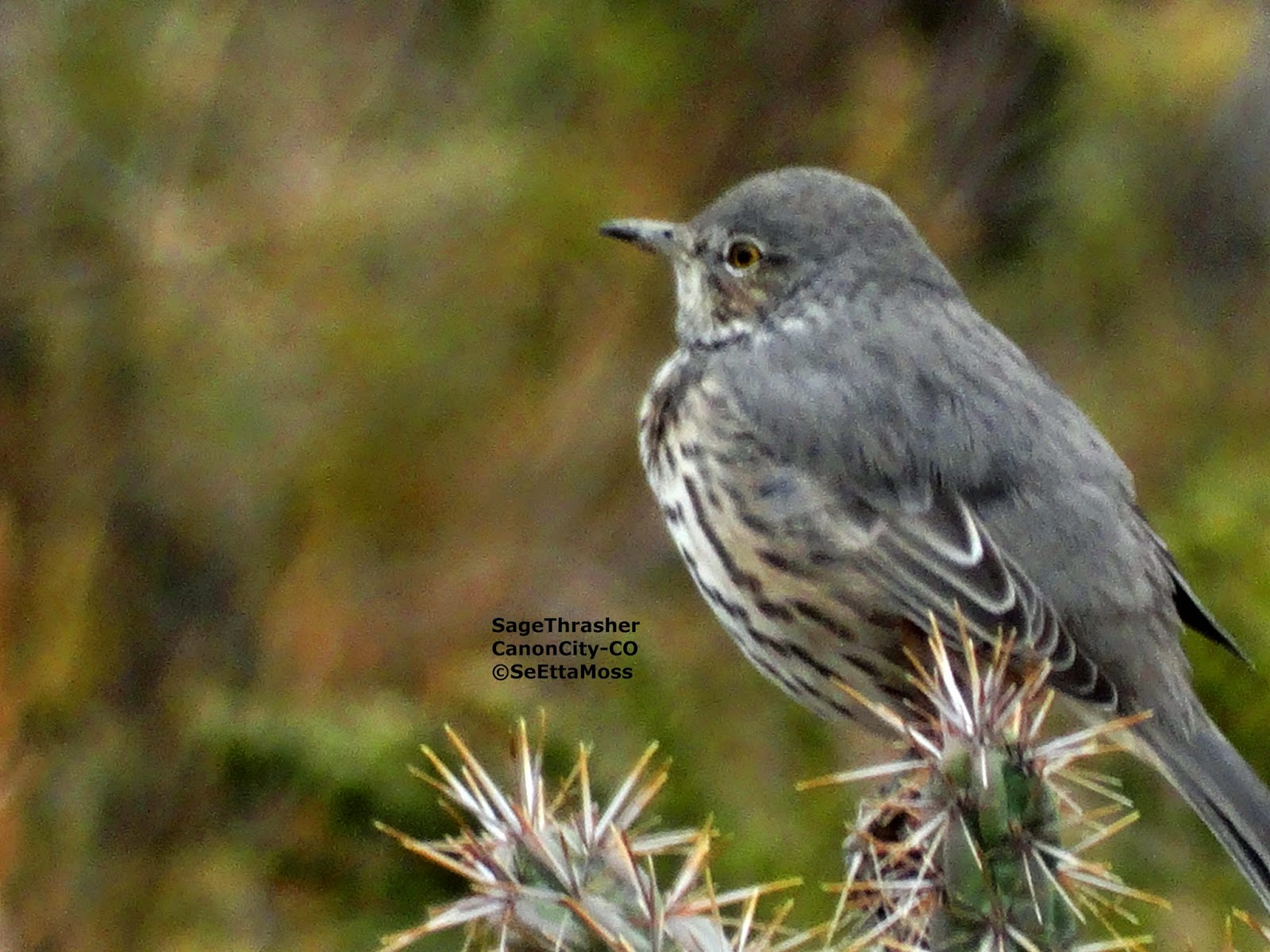
Sage and Curve-billed Thrashers

Image
I found a Sage Thrasher this week in some 4-winged Salt Brush/Cholla cactus habitat in Canon City where I usually find Curve-billed Thrashers, and it didn't take long to find two of those fairly common birds for my area. The Curve-billed Thrashers are resident while the Sage Thrasher is presumably stopping over during migration. The dark streaking on the underparts of the Sage Thrasher, along with the shorter and straighter bill distinguish it from the Curve-billed Thrasher. I included the photo just above that shows the white tips of the outer tail feathers of this Sage Thrasher--while Curve-billed Thrashers also have white on the ends of their outer tail feathers you can see in the last photo that their tails are slightly rounded. The eyes of these two different Curve-billed Thrashers are clearly orange while the eyes of the Sage Thrasher, though not as clearly visible, tend more to yellow. The Curved-billed Thrashers show definitely decurved long bills with spotted...

Orange-crowned Warbler fest on Canon City Rivewalk

Image
I did not notice how this warbler is holding it's left wing so far down as these birds were flitting about quickly. I hope it doesn't have an injured wing as this would be a problem for it's migrating. I watched well over a dozen Orange-crowned Warblers busily foraging in a mixed flock along the Canon City Riverwalk today. Actually it was at 1:30 in the afternoon when I decided to take a walk there during an interlude in the drizzly weather. I suspect the big rains we had yesterday (I got a total of about 1.25 inches at my place these 2 days) had brought them down and now they were fueling up for the rest of their migration. Most vocal in the flock were several Black-capped Chickadees but several Brown Creepers were also vocalizing. Also in the flock were a few Ruby-crowned Kinglets, a couple of Mountain Chickadees, 2 White-breasted Nuthatches and several Downy Woodpeckers. SeEtta