Posts

Ladder-backed Woodpecker on Canon City Riverwalk

Image
I was surprised to find this female Ladder-backed Woodpecker on a dry hillside adjacent to the Canon City Riverwalk. As can be seen the bird is in a tree cholla, which is their habitat in this area. Though the Canon City area is predominately semi-arid, we have a large riparian corridor along the Arkansas River and the Riverwalk parallels the river in many places. But we have cholla cactus interspersed with the riparian vegetation in dry sections including hillsides. In the three decades I have been birding along the Canon City Riverwalk this is the first time I have seen a Ladder-backed Woodpecker here though I have thought I saw one a few miles further down the river corridor a few years ago(quick look so dismissed it as wrong habitat). I did see one last year in another, though less extensive riparian habitat around a small stream. I do occasionally find them outside of Canon City in predominately cactus-grassland or juniper-cactus habitats. SeEtta

Lesser Goldfinch, haven't yet migrated south

Image
A week ago two Lesser Goldfinch arrived at my feeders the same day as three Pine Siskins, the first I had seen here this season. The Lesser Goldfinch have usually migrated south by now. Given the unusually warm temperatures (highs often in upper 60's) they may think the angle of the sun (that birds use to know when to migrate) is off. SeEtta

Rough-legged Hawk in Pueblo County

Image
I found this Rough-legged Hawk in Pueblo County day before yesterday. I believe it is a female light morph bird: thin dark eyeline with pale head, dark brown iris, streaked bib with dark belly, lightly barred leg feathers. Also the wingtips are about equal to the tail tip. In the bottom pic the white basal feathers on the upper tail are shown. This is only the second Rough-legged Hawk I have found so far this fall/winter, the other one located in the Coaldale,CO area. SeEtta

Another cool Lesser Prairie-Chicken video

Image
This video is courtesy of Linda Rockwell, birder and bird photographer who has a blog PhotoFeathers with lots of nice bird photography. In celebration of the proposed listing of Lesser Prairie-Chickens today by the USFWS. The listing may not have to come to fruition if this proposed listing can motivate the private and public entities to get serious about conservation of this species. SeEtta

Lesser Prairie Chickens proposed for T&E listing today!

Image
Video courtesy of Texas Parks and Wildlife "U.S. Fish and Wildlife Service Initiates Process to Consider Lesser Prairie-Chicken As "Threatened" Species Under the Endangered Species Act November 2012 Agency seeks information from public, scientific community to inform final decision; continues work with states on voluntary conservation agreements Based on scientific evidence that the lesser prairie-chicken and its habitat are in decline, the U.S. Fish and Wildlife Service announced today that it is initiating a process to consider whether the species should be recognized as a threatened species under the Endangered Species Act. The Service will make a final determination on whether to add the lesser prairie-chicken to the Federal List of Endangered and Threatened Wildlife based on the best available science. Members of the public and scientific community are encouraged to review and comment on the proposal during the 90-day public comment period. State conservation ...

Female Williamson's, dressed for blending in

Image
Female Williamson's Sapsuckers are not boldly plumaged like their male counterparts. Like in many bird species, females of this species have plumage that blends in with it's environment which is important so when they are nesting they do not draw too much attention to themselves (and where their nest site is located) by possible predators. SeEtta

Gorgeous Williamson's Sapsucker

Image
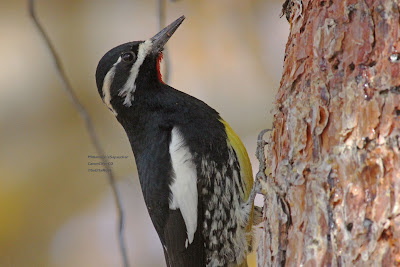
I found this male Williamson's Sapsucker this week in Canon City. By this time of the year, it is most likely that this and the other sapsuckers are going to winter here. Yesterday I drove from location to location where I have found sapsuckers and came up with 1 juvenile Yellow-bellied, 3 male and 2 female Williamson's Sapsuckers. SeEtta