Posts

Olive-sided Flycatcher, still declining in numbers

Image
This Olive-sided Flycatcher was an unexpected surprise on my trip to the Lower Arkansas Valley of Colorado last week. I found it giving it's 'quick free beer' call in the limited forest edge around Lake Holbrook. The top photo is really such a classic view showing it's distinctive dark vest an it's very short tail. The is a species of concern with continuing significant population decline. The tufts of white feathers on it's rump, another feature of this species though not always visible, can be seen in fluffed up bird in the bottom pic. SeEtta
Mississippi Kite: here's looking at you

Image
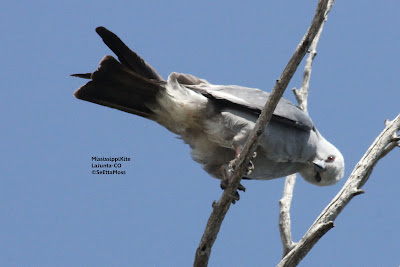
This is another specialty species I was looking for when I traveled to the lower Arkansas Valley area last week. I found this kite in La Junta where there were several others flying high in the sky. Though I took the pic from my car as I often do to reduce disturbance it heard the mechanical clicks of my digital camera and looked right down at me. Fortunately it didn't disturb it too much as it went on to scratch an itch as shown below. I suspect those claws do a good job of scratching. SeEtta

Singing Dickcissel, close-up

Image
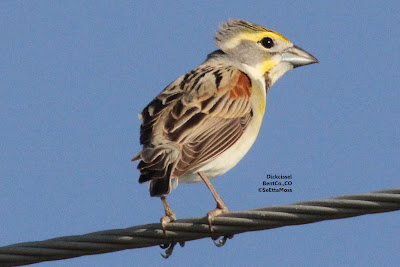
This photo was so good I was able to crop it for a very close-up view and like the others is tweak-free (no other editing). It is really nice to see the rufous shoulders that are not always seen on these birds. And what a coincidence, today I heard a Dickcissel singing in a farm field in the Canon City, CO area;however it was so distant I was unable to locate it visually. That was a surprise as this is the far edge of their range so they are not always in this area every summer. SeEtta

Distinctive Dickcissel

Image
I drove down to the lower Arkansas Valley a few days ago to look for some special species and I was successful in finding Dickcissel, a species I truly enjoy listening to. I was concerned that they would have a difficult time finding suitable habitat as they use hay fields since we have converted much of the grassland. And this year due to very warm spring the hay fields were high and being cut sooner than usual. In fact I found many hay fields had already been cut but did find 3 or 4 male Dickcissels still singing their hearts out in uncut fields. I had such great mid-afternoon light that these photos came out so nice all I did was crop them to enlarge the birds. SeEtta

Black Phoebe at nest: video clip

Image
In this short video clip one of the Black Phoebe parent birds can be seen perched above and to the left of the nest, very obvious by it's frequent tail wagging. It then flies to the right where it catches an insect off-view and quickly returns to the nest to feed the 6-9 day old nestlings (same day as photos in post below). Video clip is best viewed in full screen format (click on box in far right-bottom corner of screen) SeEtta

Black Phoebe nesting: 6-9 days old

Image
The top pic shows one of the Black Phoebe very young nestlings when it is between 6-9 days old. At this stage it's beak is very large relative to it's size. In the pic below, taken the same day, one of the parent birds is feeding the nestlings. SeEtta

Raven with nestling inside cave nest

Image
This was the most difficult as the parent is inside the cave with the nestling. I think the parent bird is fairly easily visualized perched on the left side of the nest facing to the right. Not as clear is the nestling that is also in the nest, right in the middle of the pic, and just below and facing the parent bird. It is interesting how our eyes are better able to accommodate this as the birds inside the nest are better seen with a spotting scope than through this 400mm camera lens. It may help to enlarge this photo, done by double clicking on it. SeEtta