Posts

Another prob Colo albino hummingbird (Phantom Canyon Ranch)
Image
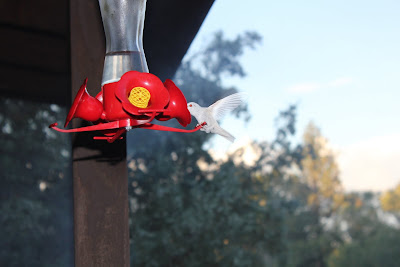
Photo ©Carolina Kyvik Ruiz This little beauty was seen from Sept 2 through 6 on the Phantom Canyon Ranch, NW of Livermore, CO. The top photo,courtesy of Carolina Kyvik Ruiz, clearly shows a red eye and white plumage plus when further enlarged the feet appear to be whitish. (Click on pic to enlarge it for better viewing) The bottom pic courtesy of Robin Mitchell shows a pinkish bill. All of these characteristics are those found in albino hummingbirds as I note in my post below about a probable albino hummingbird in the Salida area. Since I have been told that the Salida area probable albino may have returned on several days after it was first seen, this may be a second hummingbird seen in Colorado in the past several weeks that appears to meet the criteria for albino. Thanks to Douglas Murray for providing the opportunity to share this white beauty here. There is a photo of a white hummer found in New Jersey with a link to a video of it on this Bird and Blooms magazine blog site...

Ted Eubanks takes on birders

I found this in a recent publicly viewable blog by Ted Eubanks for the American Birding Association (his blog is quite lengthy as is some repartee that a very conservative ABA member enters into with Ted, all readable at the link).  Ted always has a way with words and well-honed ability to get under peoples' skin: "Bird conservation is fundamentally about politics, and politics is fundamentally about body count. Yet birding is cursed by being a closed community, a clique where members are more interested in impressing each other than in explaining the wonders of birds to the world outside. How else can you explain big years, big days, life lists, tics, twitches, the minute differences between the Empidonax flycatchers, and the like? . . .  But to protect birds and birding from these recent Teaper assaults, birders and birding will have no choice but to engage the public. I have seen little evidence of a willingness to do this in the past. I see little reason to b...

Prob hybrid dark ibis in Colo

Image
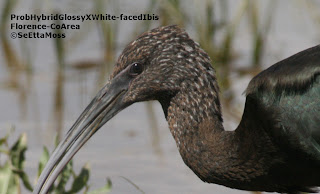
Since the small flock of Plegadis ibis were moving around as they were feeding in the flooded agricultural field, I cannot say if these are from different or from the same bird. In the lower pic there is an additional Glossy Ibis field mark showing that does not show in other pics. In his book Advanced Birding Kaufman states, " the shape of the pale border on Glossy Ibis is quite consistent. The upper border widens between the eye and the bill . . . ." (p.40) Kaufman also notes that Glossy Ibis "retain at least a hint of this pale edging all year" and each of these pics in this post and in the previous post show pale edging which looks slightly bluish to me. There are other field marks such as very small size difference and leg color that seem less reliable for separating these two species in winter. (click on each pic to further enlarge) I looked on the internet for pics of White-faced Ibis in Basic plumage and this webpage (JohnAvise, CA) can be enl...

Probable Glossy Ibis near Florence,CO-now prob hybrid GlossyXWhite-facedIbis

Image
Having just read a big discussion about identifying Glossy Ibis in non-breeding plumage (actually the facial skin is the issue most discussed) as the field marks are substantially less obvious in field after breeding season. Both of these pics are of the same bird, top just further enlarging it to show more detail. I photographed this along with several other Plegadis ibis in a flooded field near Florence, CO earlier this week. As can be seen in both pics this bird has a dark brown iris which though a field mark for Glossy Ibis is also seen in juvenile White-faced Ibis. (Birds of North AmericaBNA online states, "immature White-faced until at least first winter has gray-brown iris ") However, this bird appears to be an adult in Basic plumage per BNA and article on Plegadis ibis published in Sora by Patten and Lasley which states, "It is straightforward to distinguish between a Plegadiis in Juvenal plumage and one in basic plumage. A. uniform muddy-brown head ...

Burrowing Owl: does it have ear tuft?

Image
I took these pics just a few days ago of a Burrowing Owl in a prairie dog town in some nice short grass prairie in Crowley County, Colorado. I didn't notice until I uploaded these pics that it appears to have 'ear tufts,'(not part of ear structure but tufts of feathers) a characteristic this species of owl is not supposed to have. I have checked "North American Owls: Biology and Natural History" (2nd Ed) by the well respected ornithologist Johnsgard and it said this species is without ear tufts. I also checked a number of online sites including Cornell's 'All About Birds' and they all noted that Burrowing Owls do not have ear tufts. That is with the exception of a 1981 article "Adaptive Significance of Ear Tufts in Owls which listed Burrowing Owl as one of the species with ear tufts. Now one could maybe disregard this rather old single study except that it was published in the prestigious ornithological journal Condor . Be sure to click o...

Standoff-"It's my doggie" or Red-tailed Hawk vs magpies and vulture

Image
I spotted this strange assortment of birds in a prairie-dog town in Otero County. The Red-tailed Hawk had nailed a prairie-dog and was clutching it in it's foot while Black-billed Magpies and a Turkey Vulture brazenly crowded the pressured hawk. When the hawk flew a short distance it was followed by the magpies and another vulture that had been circling. Given the terrible drought that has plagued this area all summer it would seem that scavengers like these magpies and vultures are emboldened. SeEtta

Migrating sandpipers: sewage ponds

Image
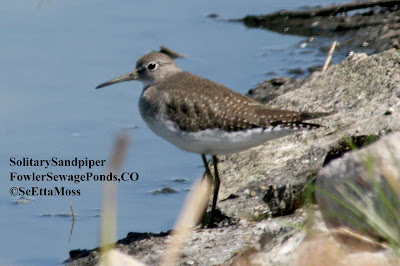
Yesterday we had the first truly cool day, only in the 70's, in more than 2 months so I drove down to the lower Arkansas Valley (which has been in upper 90's to 100+) to look for migrating birds.  I stopped at Fowler Sewage Ponds where I found the best assortment and number of migrating shorebirds this trip--there is nothing like sewer ponds for shorebird action.  I was delighted to find several, at least 3 or 4 Solitary Sandpipers in various sections of these sewage ponds including the one in the top pic. The bottom pic shows one of the Semipalmated Sandpipers--CORRECTION: this is a juvenile Least Sandpiper (thanks to Christian Nunes for catching this). Also there were Western and Baird's Sandpipers, a few Greater Yellowlegs, dozens of Killdeer and some Wilson's Phalarope. SeEtta