Posts

Quite a find--a Worm-eating Warbler
Image
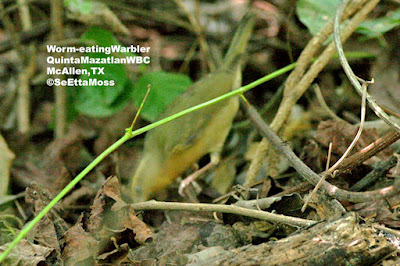
I have been enjoying not only Rio Grande Valley specialities but some migrating warblers these past 4 days. Today I birded Quinta Mazatlan, one of the "World Birding Centers" in the Rio Grande Valley. I was quite frustrated and almost left because there was so much noisy maintenance work being done to the grounds, partially because they had a big earth-day celebration there over the week-end. I am glad I hung in because I found this Worm-eating Warbler that is migrating through. Though this pic is not great it was the best I could get as this bird was sticking to thicket areas that were dark and had lots of vegetation in the way. In fact, the blurriness on this pic is from some vegetation between me and the bird. It does show the blackish eye stripe and some of one of the crown stripes that are distinctive with this species. Other viewable field marks, as described in Birds of North America online are as follows: "Remaining upperparts largely olive green; lacks w...

Quinta Mazatlan Canada Warbler

Image
I found this male Canada Warbler working mid-canopy during it's migration stop-over in the trees at Quinta Mazatlan. The top pic shows some of the field marks of this species. Though not as good the bottom pic shows it's black streak "necklace" and a clear view of the full eye-ring. SeEtta

So Texas & Crested Caracaras

Image
Though I saw a few Crested Caracaras in the Uvalde area (at the edge of Texas Hill/River Country & the beginning of South Texas), the numbers I saw this afternoon as I drove into South Texas were impressive--about 30 in under 300 miles or about one for every 10 highway mile. Crested Caracaras are quite distinctive in appearance, even in flight, as shown in these pics. Though their faces are usually only viewable with binoculars, their bright orange facial skin (ironically matching their legs) stands out. Though they will take live prey, both invertebrate and vertebrates, they also eat carrion and are known to join vultures to chow down on some rotted delight. SeEtta

Best bird--Golden-cheekedWarbler

Image
This bird will likely be the best bird of the trip because the Golden-cheeked Warbler is an Endangered Species and listed as 'one of the most at-risk species in North America' by the National Audubon Society. It's breeding range is restricted to fewer than 25 counties in Central Texas. The neatest part of seeing this Golden-cheeked Warbler was watching it go to a nest which is visible in the lower pic. This male bird stayed at the nest for a minute or so, possibly feeding a female on the nest or maybe doing some work on the nest (females do most of the building but males may assist) According to Texas Parks & Wildlife , "Golden-cheeked warblers are endangered because many tall juniper and oak woodlands have been cleared to build houses, roads, and stores. Some habitat was cleared to grow crops or grass for livestock. Other habitat areas were flooded when large lakes were built." SeEtta

Neal's Lodges on the Frio River

Image
I had arranged to meet Bob Rasa, who leads tours around the famous Neal's Lodges on the Frio River in Concan, TX. Bob graciously offered to work me in to his schedule and I spent the day benefiting from his experience with the birds in this area. We birded around Neal's Lodges in the morning which is where I photographed this Black-throated Sparrow. I also saw this Long-billed Thrasher at the Neal's. This species has a fairly limited range, mostly in Mexico but coming into south and central Texas. SeEtta

Black-belliedWhistlingDucks

Image
I was surprised to see these (and several other small groups totaling around 20) Black-bellied Whistling Ducks flying over Lake Nasworthy in San Angelo,TX--this is West Texas and I think of these ducks as South Texas neotropical specialties. I don't recall seeing any here during earlier trips. But when I checked the range map in Sibley's "Field Guide to Birds", I found that they are also found in central plus northeast Texas with an even wider vagrancy range. I did read that they have expanded their range signicantly over the the past 39+ years--hey, maybe they will show up in Colorado some day. SeEtta

Skulking wren

Image
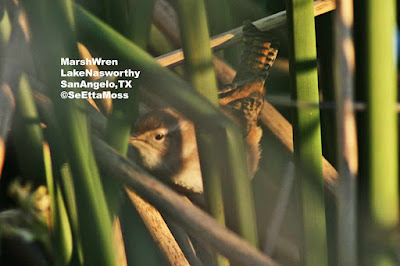
This Marsh Wren was behaving like Marsh Wrens do, skulking in the vegetation. This one was not technically in a marsh but rather in the reeds along the edge of Lake Nasworthy in San Angelo, Tx. There were also Black-crowned Night-Herons in the wider vegetative areas but I couldn't get a pic when one of them flew out nearby. SeEtta