Posts

Whooping Cranes had bad year

""Whooping Crane Census Flight March 15, 2009 The ninth aerial census of the 2008-09 crane season at Aransas was conducted March 15, 2009 with USFWS observer Tom Stehn in a Cessna 210 piloted by Gary Ritchey of Air Transit Solutions of Castroville, Texas. ...... Whooping Crane Numbers With estimated losses that has occurred at Aransas this winter, the current flock size is estimated at 226 adults + 23 juveniles = 249. The estimated peak winter flock size was 232 adults + 38 juveniles = 270 total. Mortality Today's flight provided evidence of 3 additional mortalities, with total winter mortality now estimated for the winter at 6 adults and 15 chicks totaling 21 whooping cranes, a loss of 7.8% of the flock that was a record 270 in the fall. In the last 20 years, the current winter ranks as the worst in terms of mortality, ahead of 1990 when 7.5% of the whooping cranes (11 out of 146) died at Aransas. The 3rd worst winter in 1993 showed a 4.9% loss at Aransas (7 out of 14...
Birds buffer against virus

"18-02-2009 North American scientists studying West Nile virus have shown that more diverse bird populations can help to buffer people against infection. Since the virus first spread to North America it has reached epidemic proportions and claimed over 1,100 human lives. “This is an important example of the links between biodiversity and human health”, commented Dr Stuart Butchart, BirdLife's Global Research and Indicators Coordinator. Biodiversity is increasingly being recognised as socially and economically important because of the valuable services it provides. The authors of this latest research - John Swaddle and Stavros Calos - highlighted the “increasing evidence for economically valuable ecosystem services provided by biodiversity”. " ******* "Scientists studying the virus looked at US counties east of the Mississippi River and compared their avian diversity with the number of human cases. They found that high bird diversity was linked with low incidence of t...

Canon City Rock Wren

Image
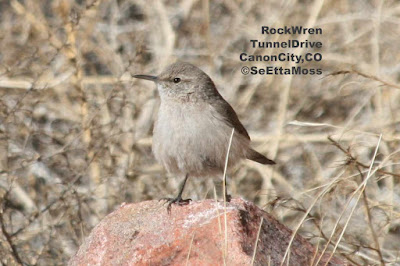
Though I don't know of any relationship to the previous post about birds wintering further north related to Climate Disruption (better term than Global Warming or Climate Change), Canon City has had wintering Rock Wrens at Tunnel Drive for some years. This is noted in "Colorado Birds" that was published in 1992. And it has been my experience at least for the past 10 years. This pic is one I took of a Rock Wren I found at Tunnel Drive. Double-click on it for a nice close-up. Tunnel Drive is an area right at the mouth of the Royal Gorge canyon just on the west side of Canon City. The Arkansas River flows just south of the location while the foothills begin here. This area also is the site for Rufous-crowned Sparrows that are resident here. This species is usually found in the southwest United States and only found in 3 other Colorado locations, all in southeast Colorado over a hundred miles from here. SeEtta

Birds wintering further north-Audubon study

Image
National Audubon Society released a report recently that showed that many birds in North America are wintering much further north than they used to. They used Christmas Bird Count data to look at where birds have been found over the a 40 year period. This graph from Associated Press shows some of the species that have been found wintering further north and the distance north. ©AssociatedPress National Audubon researchers then obtained information from NOAA on the average temperature increase in the United States. The graph of these average temperature increases parallels the graph of the increases of birds wintering further north. Read more on this research at National Audubon Society webpage. SeEtta

Another nesting owl

Image
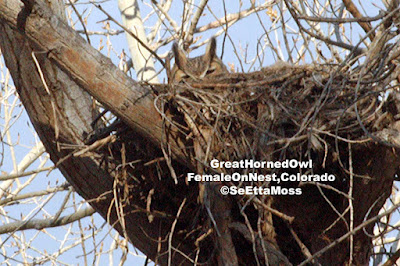
I found this female on this nest 2 weeks ago. She is one of the pair of Great Horned Owls I heard engaged in duetting in early December. Interestingly, she (her voice clearly higher pitched than the male) was perched on this same nest while she sang. The male sang from a branch of a cottonwood about 50 feet away. SeEtta

Great Horned Owls nesting in Colo

Image
Female Great Horned Owls are "on the nest" all around eastern Colorado. I have been owling around south central Colorado for about a month and have found 2 Great Horned Owls on nests including the one in this photo that is sleeping or at least resting with her eyes mostly closed. Double click on the pic for a close-up which reveals her left eye slightly open, evidently aware of my presence though I always try to be as quiet as possible (the darn digital cameras make noise when the shutter is snapped that is clearly noticed by some birds). This is the type of impact that is often unseen or ignored by birders and especially bird photographers. Not only I but other Colorado birders have reported owls on nests for the past few weeks.Besides the 2 on nests, I have seen 3 other Great Horned Owls in 2 counties. I also spotted a Western Screech Owl. Great Horned have been singing since December. In fact, I heard a pair engaged in duetting in early December (seemed a little early...

FAA Agrees to Study Lighting Requirements for Bird-Killing Towers

I am delighted that the Federation Aviation Administration is going to do this study: >>The Federal Aviation Administration (FAA) has announced plans to conduct a study that will examine whether steady-burning sidelights on tall communications towers, which attract birds and cause them to collide with the towers during night migration, can be safely eliminated without endangering air traffic. Unlike many waterfowl and birds of prey, most songbirds migrate during the night, with up to several billion birds having to navigate a landscape littered with as many as 100,000 lighted towers each spring and fall. American Bird Conservancy and its conservation partners have been working together with the communications industry in seeking this important study, which will help determine whether the safety of pilots can be maintained while also reducing the impact of lights on migrating birds. Read more . SeEtta