Thursday, November 5, 2009

Rufous-crowned Sparrows up close


Earlier this week I stopped by the Tunnel Drive Trail area to take advantage of the beautiful Indian summer fall we have had this week. Because the Tunnel Drive area is located as the mouth of the Royal Gorge canyon, which serves as a funnel that makes for strong winds, birding here can quite nasty when the temps are cold. Since there wasn't any construction happening in the parking area, I decided to check out what they are doing and look for Rufous-crowned Sparrows.
I was in luck--the Rufous-crowned Sparrows apparently have found the disturbance from the mud & rock slide a few months ago plus the city's construction of a catchment area for future slides to their liking. One bird popped up less than 15 feet from me and though it quickly flew on I was able to refind it in a few minutes and got these nice pics. These are the best photos of this species I have taken in all the years I have followed them in this area. In fact these (taken handheld) are almost as good as the pics I got of this species in the Texas Hill County last spring when I used a tripod. SeEtta

Tuesday, November 3, 2009

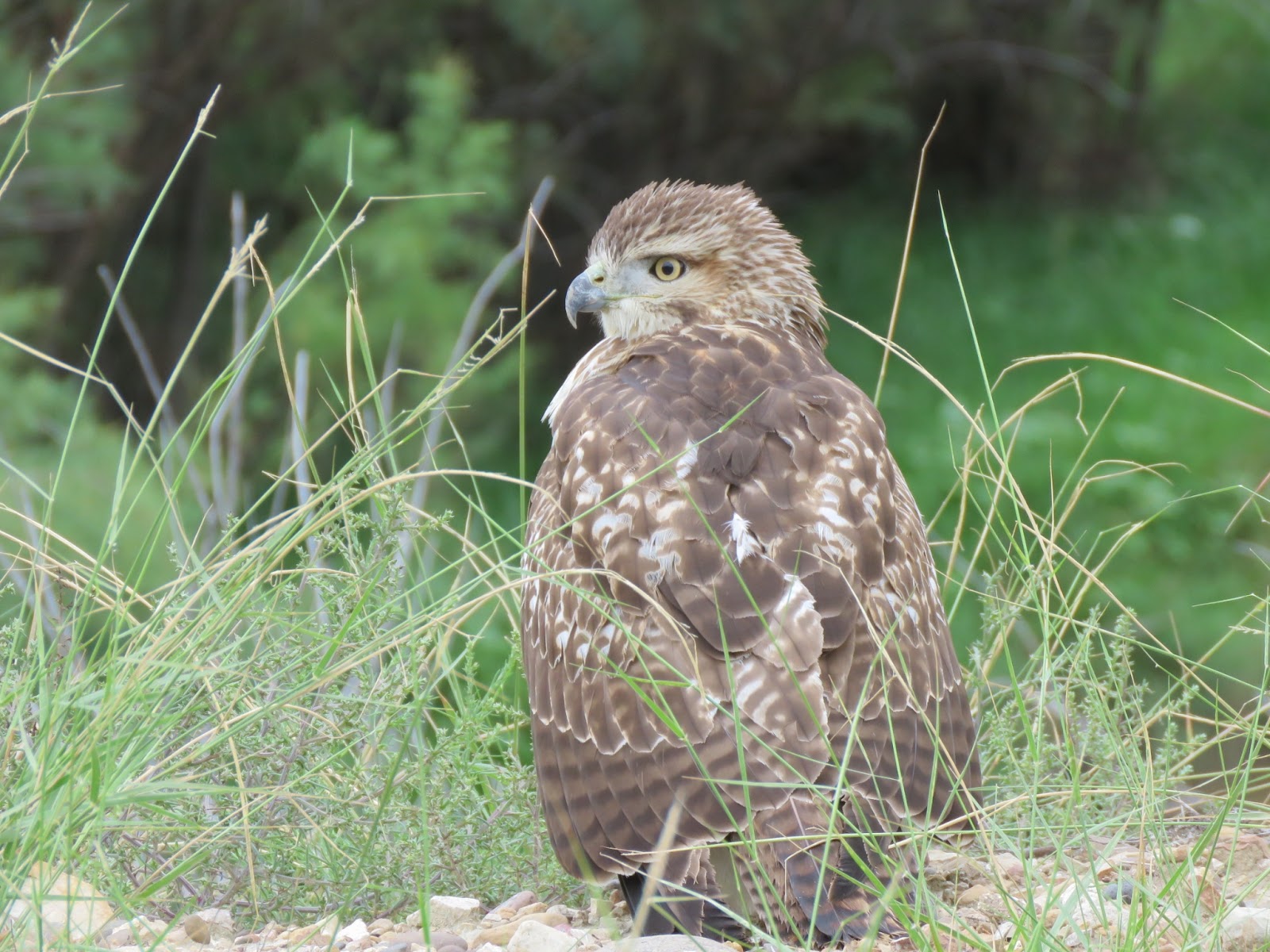
More pics of Western Red-tailed Hawk

Postnote 11-7-09--I found out tonight that Jerry Liguori, author of Hawks from Every Angle, who said it was just a Western subspecies, not an intergrade. After some feedback I received, I thought it might be useful to add these two additional pics that, though of lesser quality than those below, more clearly show the white streak on this hawk's nape, the white on it's supercilium plus the sparse white mottling on it's otherwise dark brown and rufous breast. Also just a note that this bird is clearly an adult, the age demonstrated by it's dark brown iris, so the white feathers are not due to juvenal plumage. SeEtta

Monday, November 2, 2009

Western Red-tailed Hawk, not an intergrade with Harlan's

Postnote 11-7-09--I found out tonight that Jerry Liguori, author of Hawks from Every Angle, who said it was just a Western subspecies.
Yesterday I spotted this hawk on the other side of H50 in Pueblo West. It was a pain to get turned around on this 4 lane divided highway with restricted access but worth it for what turned out to be as interesting as it looked at 60 mph. Now it does meet the criteria for an intermediate (rufous) morph "Western" (B.j.calurus) subspecies of Red-tailed Hawk as described by Brian Wheeler in Raptors of North America (p.325): "Overall, the head looks dark rufous-brown" with dark brown upperparts and dark brown and rufous underparts, and a banded rufous tail with wide black subterminal band. I think it is a moderately marked type with dark brown diamond shaped marks that form a belly band that is fairly distinct from the mostly rufous breast.
However, this bird has a small (pretty narrow) but clearly white supercilium plus some "white harlani mottling" on it's dark brown & rufous breast--traits described by Wheeler as characteristic of an adult intermediate morph intergrade with traits of both calurus and harlani subspecies of Red-tailed Hawk.
Though this hawk has many traits of "Western" subspecies, besides the traits of the Harlan's subspecies noted above it also has white streaking on it's nape that is best seen in the 2nd pic. It also has whitish lores but I am not sure how they fit with either subspecies. For quite good super close-up views, double-click on each pic. SeEtta

Residents: Am. Kestrel & Brown Creeper

Unlike the Cedar Waxwings which come and go during the irruptions, and the migrating Hermit Thrush, both American Kestrels and Brown Creepers are year-round resident species in the Canon City area as well as much of Colorado. I photographed this Am Kestrel on the grounds of the Canon City Abbey, apparently a favorite hunting area for this bird as I have seen it there a number of times in the past few week. The Brown Creeper was foraging actively at the Canon City Riverwalk in the company of a second creeper, an association that I often see with this species in the fall. SeEtta

Sunday, November 1, 2009

Yummy juniper berries for waxwings

I really like the top pic as it shows not only the juniper berry in the Cedar Waxwing's bill, but also a little of the inside of bird's bill and a nice view of it's pretty eye. I added the bottom pic because it shows off the crest that has been flattened in my other pics. SeEtta

Cedar Waxings again

This morning I went looking for Cedar Waxwings to check out what they are feasting on. I found Cedar Waxwings in an additional location in Canon City today--that makes three different locations so far with two locations far enough apart there evidently at least 2 flocks in town. As shown in the top pic, juniper berries were on the menu again.
Most photographers only show pics in which the bird's head is seen and I tend to be the same way; however, I thought the bottom pic provided an interesting back view that shows the wings and tail quite nicely. SeEtta

Thursday, October 29, 2009

Hungry Hermit Thrush pics

During the 20-30 minutes I watched and photographed this Hermit Thrush, I watched it consume a seed (not sure what plant those seeds were from but several more are visible in the pic) shown in upper pic and several juniper berries. Interestingly, they are well known as insect feeders that eat more berries in winter but often seeds are not mentioned (other than berry/fruit seeds). Ir also appeared to drink some water from the melted snow in the street. SeEtta

Her

Migrating Hermit Thrush

I found this migrating Hermit Thrush in Veteran's Park in Canon City,CO this morning. Actually there were two Hermit Thrush but the second bird was more secretive, a characteristic for which this species is known. However this bird came out into the open and foraged within 15-20 feet of me. Twice it flew under my car which put it quite close to me but out of sight. The second bird stayed in the juniper trees next to the park road.
I included the bottom pic as it so clearly shows it's reddish tail, back and wings so nicely. It also shows it's how this species holds it's wings in an outward manner (they also flick them). More pics in next post. SeEtta